
Showcasing - Enyo's Escape Trailer
Enyo's
Escape

Project Type: 2D Web Video Game
Roles: Concept Artist, Sound Engineer, Video Editor, Level Designer & Programmer
Associated With: 
Awards:
2024 Finalist
@
SBU Annual Game Programming Competition
Quick Links:
Table of Contents
Trailer
Overview
Contribution
Artwork
Sound
Game Features
Engine
Play Testing
Conclusion
Technologies Used
Main |

TypeScript |

Piskel |

Tiled |
(cont.) |

Audacity |

ChipTone |

Online Sequencer |
(cont.) |

DaVinci Resolve |

OBS Studio |

Wolfie2D |
Project Info
Enyo's Escape
Enyos Escape Game Trailer (Contribution)All Roles:Concept Artist, Sound Engineer, Level Designer/s Programmer/s, Video Editor (Additional Role For Finalists) Awards:2024 Finalist @ SBU Annual Game Programming Competition All Levels: (7 Total)
Level 1 & 2: Desert |
Table of Contents
|
Overview
Project DescriptionShowcasing - 2024 Finalists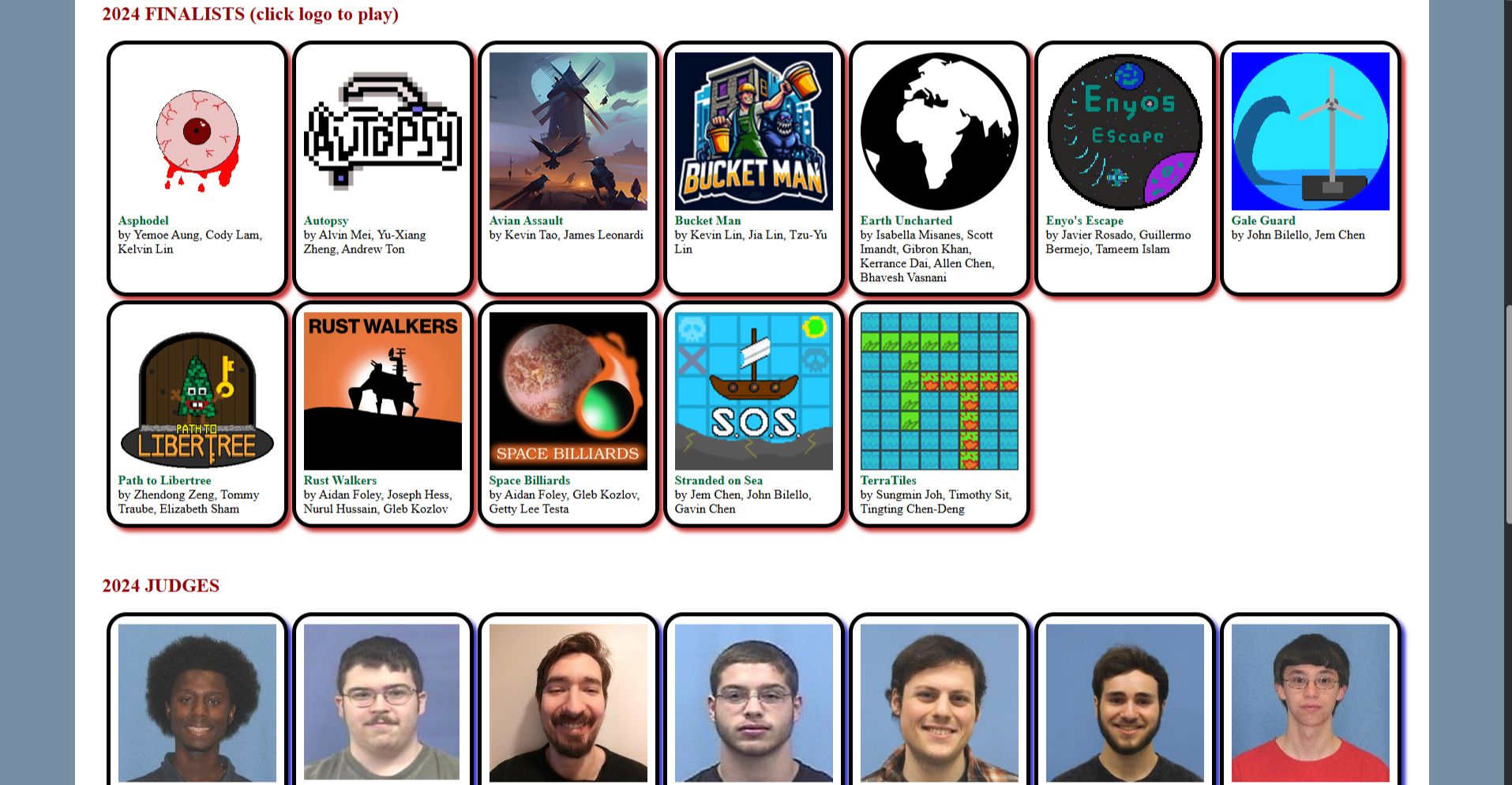
Overview - Annual SBU Game Programming Competition (2024 Finalists)GoalThe goal of the project was to create and deploy a 2D platformer game to compete in the 20th Annual Stony Brook University Game Programming Competition. Enyo's Escape made it as a 2024 Finalist. Enyo's Escape and programmers were inducted into the competition history as a 2024 Finalist. TechnologiesTypescript was the main language of choice used for Enyo's Escape with Firebase chosen as the service for deployment. For the game's artwork, Piskel and Tiled were used for creating all levels and characters with the latter being used for designing game levels after the appropriate tilesheet's creation. For the game's music, Audacity, ChipTone and Online Sequencer were used for creating all sound effects and level music with the last mentioned being used specifically for the game trailer. Finally for the game's trailer used in submitting for the competition, DaVinci Resolve and OBS Studio was used. This game used a custom game engine created by Stony Brook University computer science students, known as the Wolfie2D Engine. A few tweeks needed to be made in order to make Enyo's Escape's enemy interaction and movement run more smoothly. Concept OriginShowcasing - Competition History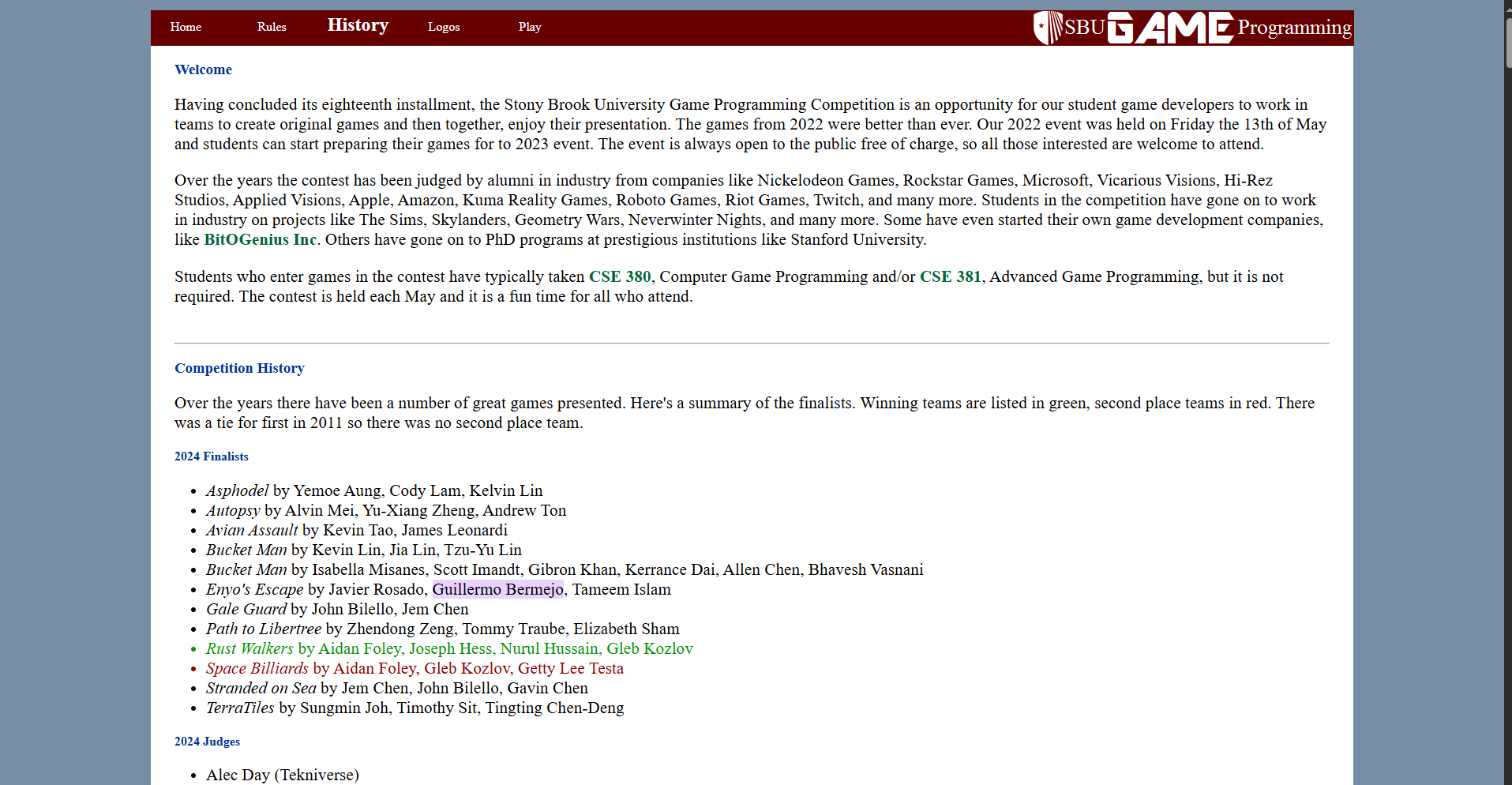
Overview - Competition History (2024 Finalists)ExplanationThe main concept for this game was originally to be a starship shooter. Before commiting and implementing this style of game however, we decided to conduct a small, one day survey at Stony Brook University to determine the most desirable genre of game for a 2D game out of 3 genres (platformers, starship, top-down). The winner was the platformer genre which lead to the overhauling of the original concept idea in order to create a game more entertaining and player-friendly in terms of difficulty for newer players. The idea was to use 3 different modes each set with different strengths and weaknesses to overcome different sets of obstacles in order to progress through the level. The final result was the following concept for Enyos Escape: "Enyo's Escape": An Alien Prince crash lands on Earth and it is up to you to get him through Earth's desert, find his ship and head home to the stars. More information on the game's lore can be found in the Contribution: Game Lore subsection of the Contribution section of this page. Team RolesProgrammers: Guillermo Bermejo, Javier Rosado, Tameem IslamFor this project there were to be mainly 4 types of roles, that of the artist, sound engineer, level designer and programmer. With our team already having a background in computer science however, we all decided to program to gain experience with Typescript. One member focused on the UI and 'cheatcodes' of the game, while the other member and I focused on player mobility and player-level interaction. I alone later implemented a few game features to address some feedback given by players from who play tested Enyo's Escape. These players were from Stony Brook University's Game Development & Design Club. More information on my contribution with programming can be found in the Contribution: Game Features subsection of the Contribution section of this page. Level Designers: Guillermo Bermejo, Javier Rosado, Tameem IslamFor this project all members designed at least 2 levels each after the concept artwork for their level was completed. The following members contributed the following level design for Enyo's Escape.
Guillermo Bermejo: Level 5, Level 6, Secret Level More information on my contribution with level design can be found in the Contribution: Level Design subsection of the Contribution section of this page. Sound Engineer: Guillermo BermejoThis role was something I insisted I take upon myself. Music is something I enjoy in my spare time but the main reason for my instistance was primarily from my hobby with video editing which includes sound editing for music video covers. This combined with my admiration of the nastalgic 8-bit style including 8-bit music naturally had me insist. In this role I composed original game music for the space levels, lab levels and desert levels as well as the sound effects used. My final work with this role was creating the trailer theme for our submission upon the decision on becoming a finalist in the SBU Annual Game Programming Competition. More information on my contribution with music and sound can be found in the Contribution: Sound subsection of the Contribution section of this page. Concept Artist: Guillermo BermejoThis role was something that was insisted I take after I designed an initial concept for the character Enyo and the art for the set of space levels. Graphic design and pixel art is something I enjoy doing in my spare time which proved to be a great asset for this project. In this role I designed the art for the original character Enyo, the logo, the set of levels as well as all enemies found in the game. My final work with this role was designing the artwork for the final unlockable mode of Enyo the 'Zen' mode which uses the combined attributes of all modes in one. More information on my contribution with artwork can be found in the Contribution: Artwork subsection of the Contribution section of this page. Video Editor: Guillermo BermejoThis role is one that emerges once a group is confirmed on becoming a finalist in the Annual Stony Brook Game Programming Competition. Teams are given 5-7 days to create and submit a game trailer to represent their game as finalists. During this time I was the only member available, however, with my prior experience with video editing, I was able to create the music, film gameplay and edit the game trailer within 2 days. The final result can be viewed again here. More information on my contribution with the making of the trailer can be found in the Contribution: Game Trailer subsection of the Contribution section of this page. |
Game Trailer
More InformationThis is a trailer that was created by me using DaVinci Resolve and OBS Studio for entering the 20th Annual Stony Brook University Game Programming Competition where Enyo's Escape and programmers were inducted into the competition history as a 2024 Finalist. More information on the creation of this trailer can be found in the Contribution: Game Trailer subsection of the Contribution section of this page. |
Contribution
Guillermo Presenting Enyo's Escape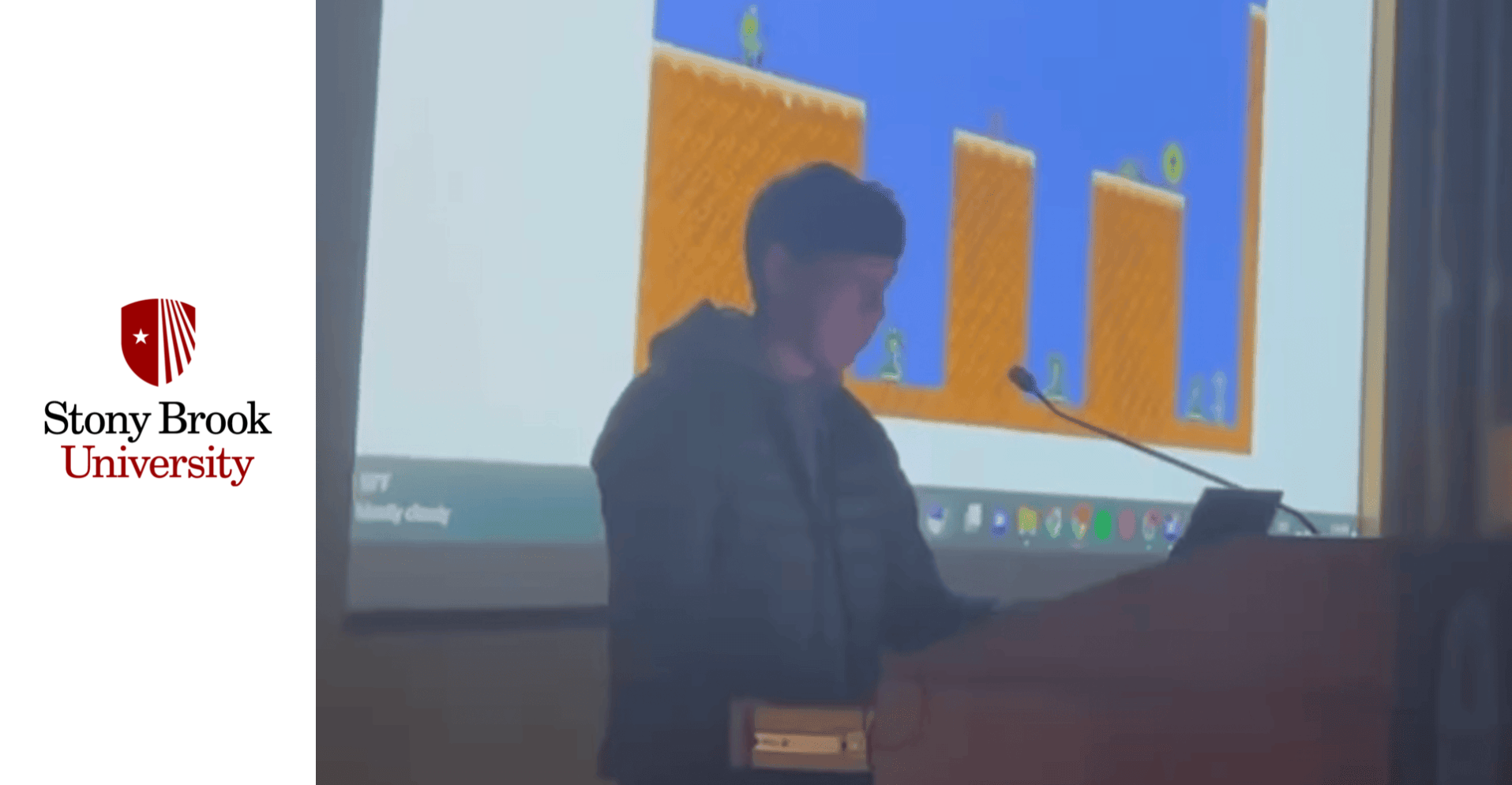
Presenting Enyo's Escape - 2024 Annual Stony Brook University Game Programming CompetitionGeneral InformationIn this section I highlight my contribution to the game 'Enyo's Escape' that made it as a 2024 finalist at Stony Brook Game Programming Competition. My individual contribution for Enyo's Escape ranges from working on all of the artwork for the game, generating and editing all of the sound and music used in the game, planning and implementing the game trailer, as well as implementing some game features after some initial feedback given to us by playtesters. As a group, I contributed to working on the core gameplay of the game, designing the space set of levels and creating the game lore. Below are quick links to the work I contributed for Enyo's Escape. The order in which I mention the topics below are the order in which I worked on them with the exception of 'Game Lore' which was discussed first but for the purpose of this section, will be discussed last. In the link table above, 'Game Trailer' is listed first as I wanted to highlight the trailer first in it's own mini-section before delving further into the game. Contribution: ArtworkOverview (Artwork)Showcasing - Artwork Aesthetic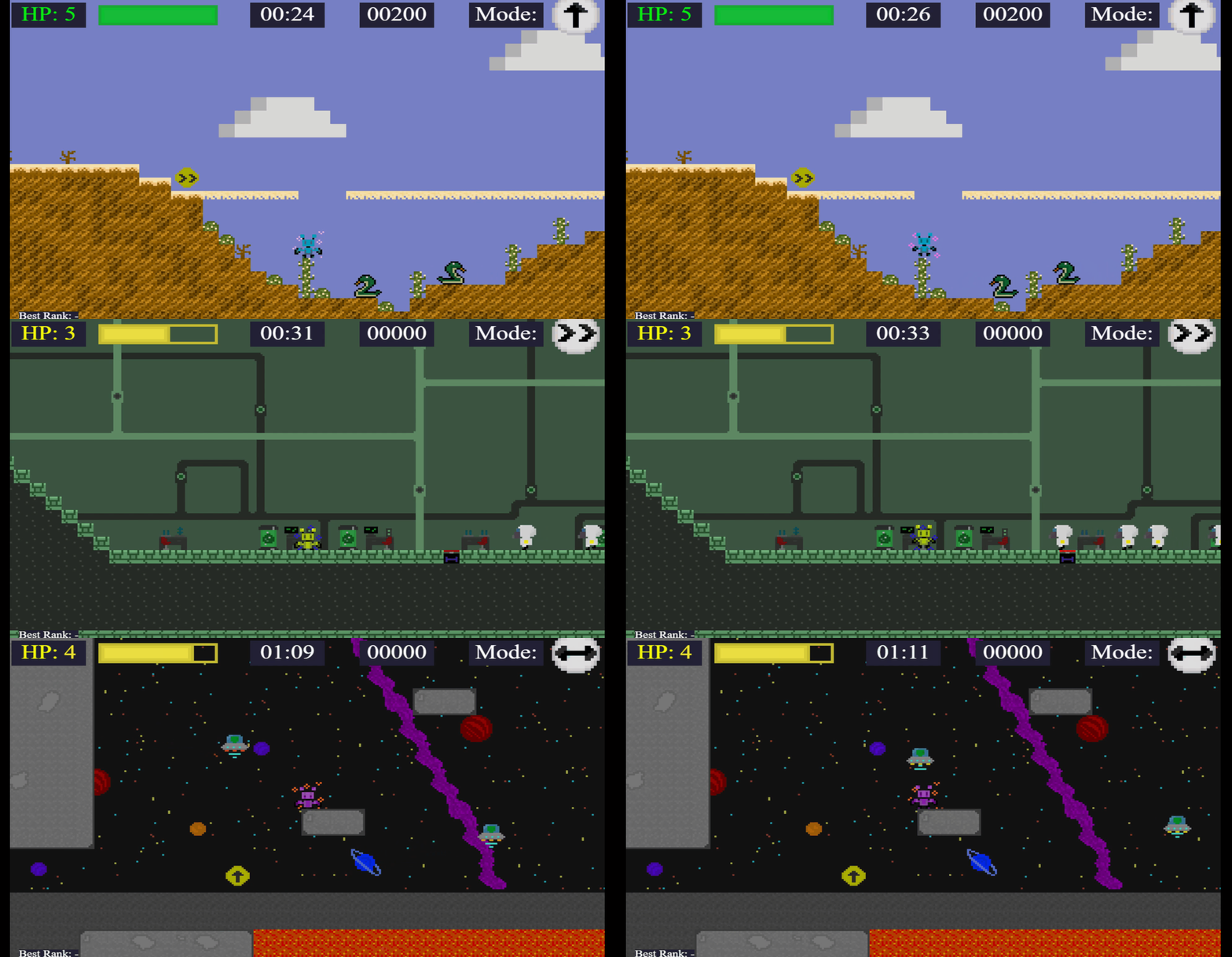
Artwork - Enyo Modes, Enemies, Level & UI ArtExplanationIn this subsection I briefly go over the following artwork I implemented for Enyo's Escape: Initially my role with working on the artwork for Enyo's Escape began with designing a demo for what the game logo could look like. Rapidly, I had became engrossed with the art the 2D pixel style is able to create and I took on the role of the concept artist after creating the game logo. I desired to gradually expand on my ambition for the artwork as the levels go up in order to work on all of the modes and enemies and allocate more time to working on the sound of the game, level design and programming of the game. For this reason, the tilesheets for the levels get much larger every level theme. Main Technologies (Artwork)Showcasing - Main Piskel Website
Artwork - Piskel (Free Online Editing Website)PiskelPiskel was the main technology used for designing the pixel art for Enyo's Escape. Before this project, I had no prior experience with this technology however, it was very user-friendly leading to the learning curve being fairly quick. the fuctionality, I got the grasp of it. For the level designs, each member focused on a specific set of levels after Once a set of animations are done, a showcase of the animation is displayed before the user chooses to download the gif of the animation. Once this gif is exported, it can then be loaded in another piskel file to finalize a tilesheet. Note: The original character pixel art is 16 x 16 pixels. All animations have been slowed down and upscaled from the game for better viewing. The original tiles in the tilesheets are 8 x 8 pixels. All tilesheets have been upscaled for better viewing. Game Logo (Artwork)Showcasing - Working On Game Logo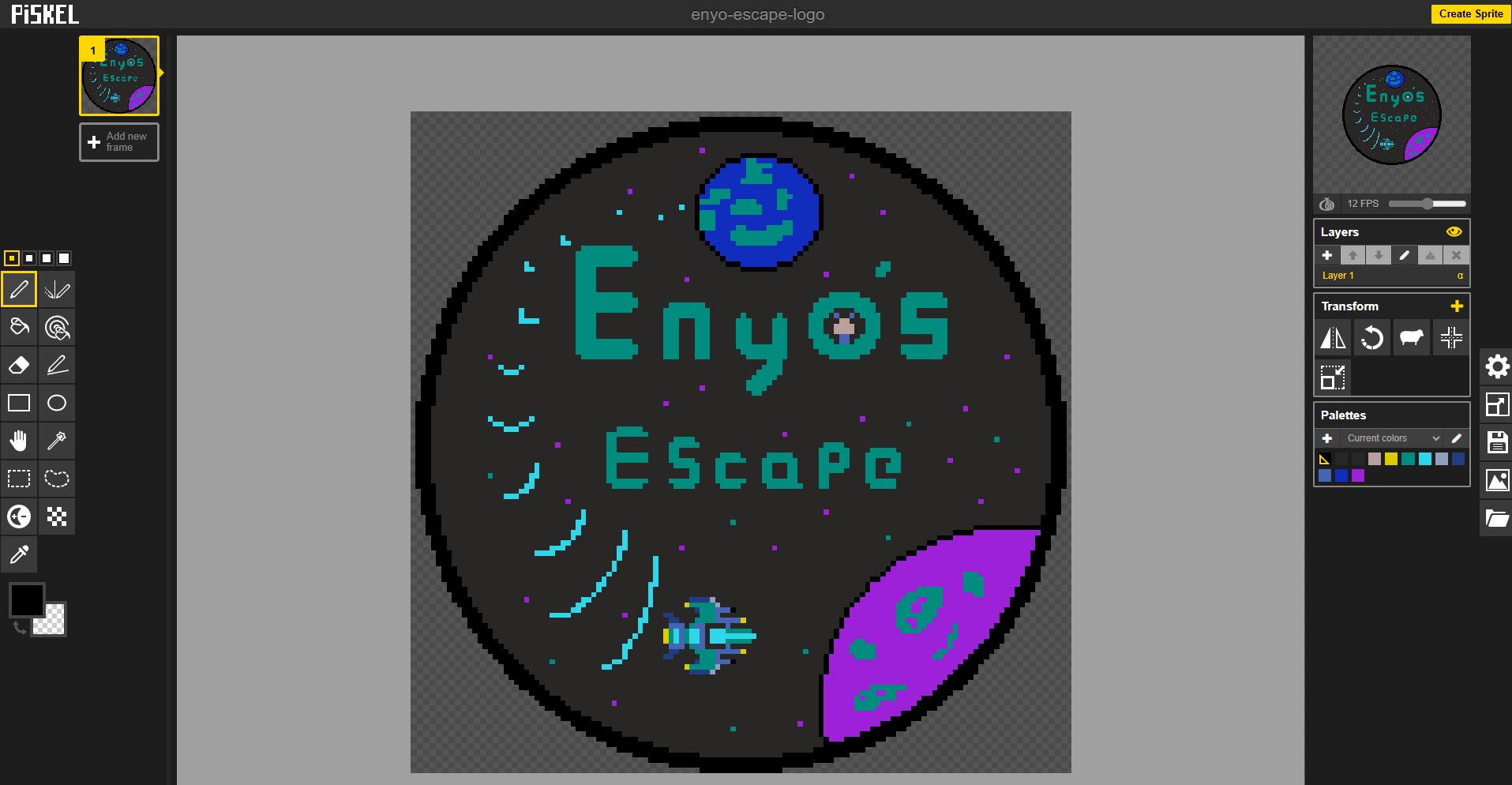
Artwork - Working On 128 x 128 Pixel Game LogoConcept ExplanationAs spoken about previously in the concept origin subsection, Enyo's Escape was originally planned to be a starship shooting game. For this reason the main logo features a starship I created that was to serve as Enyo's main vessel and the starship the player were to use. After reconsidering and switching the game type from a starship shooter to a 2d-platformer, the game lore was changed to Enyo having crash landed on Earth, needing to find his ship and escape back to his home planet. The game logo displayed this exact lore. Specifically, it depicts Enyo having successfully located his ship on earth and in the process of landing on his home planet shown by the purple planet, Midas 47. Enyo Modes Concept Art & Animations (Artwork)Showcasing - Original Enyo Concept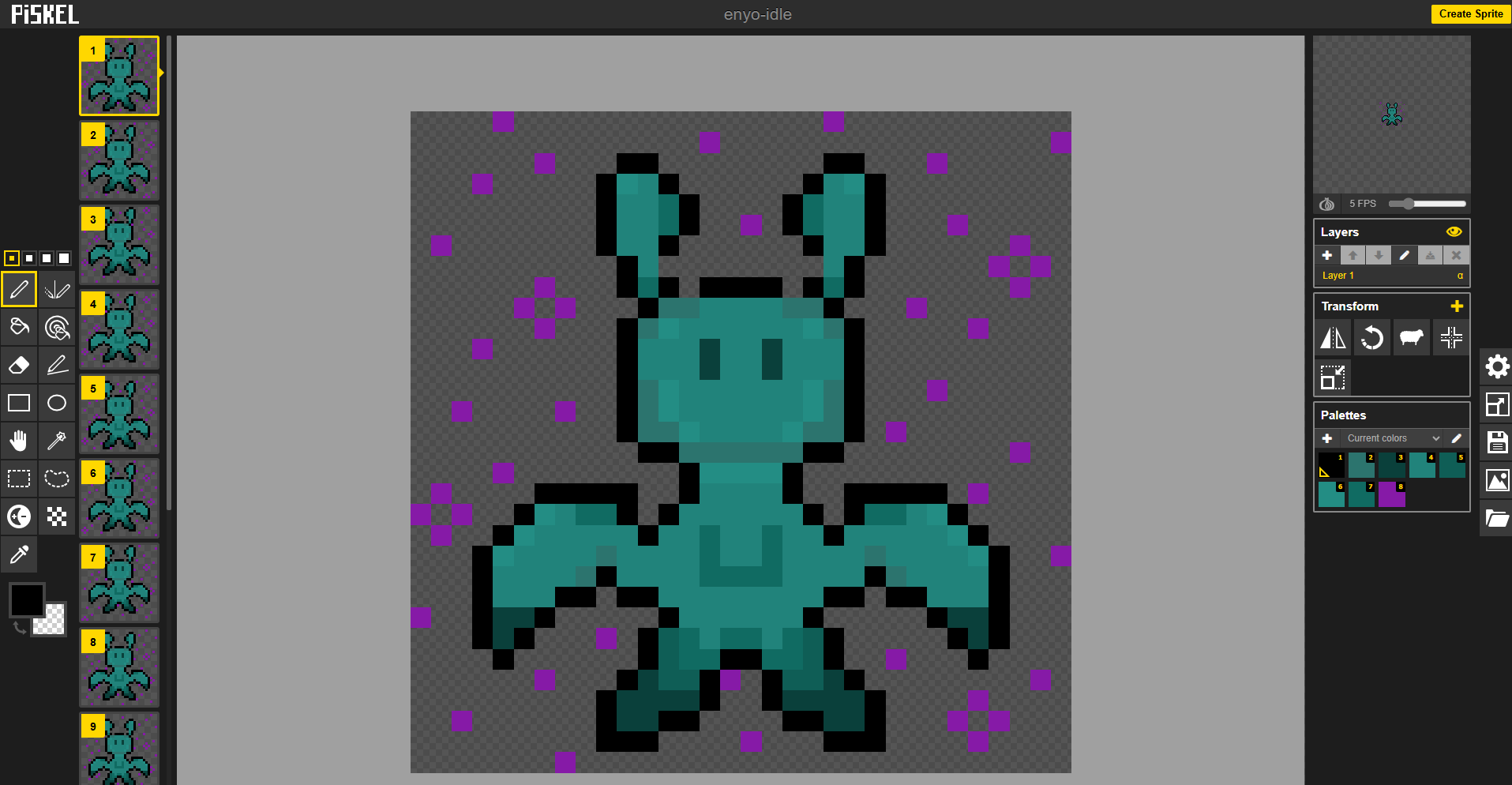
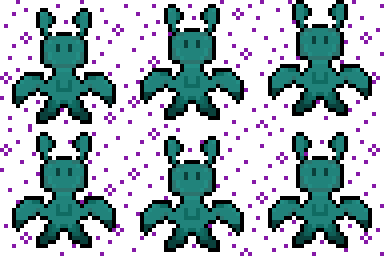
Artwork - Original Enyo Concept (32 x 32 Pixels)Original Enyo Concept To Final ConceptBefore I finalized the design of the main character Enyo, I had designed Enyo to be more 'alien-like'. Enyo's head was designed to be larger, his arms replaced with wing-like apendages and the main form of travel was through levitation. Below is the evolution of Enyo's design while in his 'idle' animation but more importantly in the 'default' mode i.e., the mode active upon entering a level.
Note: As displayed, the concept of Enyo changed over time. Specifically, from the original concepts of Enyo, I changed his color scheme to light blue instead of green. Previously, the green color was to serve as the color for the 'default' mode meaning, a form without any power, the other 3 modes were to have different color schemes. From the original concepts to the new concept, the default mode was removed and the user was to enter the game in 'jump' mode which has the color scheme of light blue and was set as the new 'default' mode.
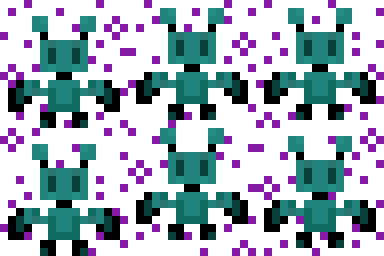
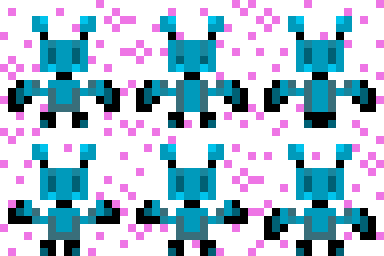
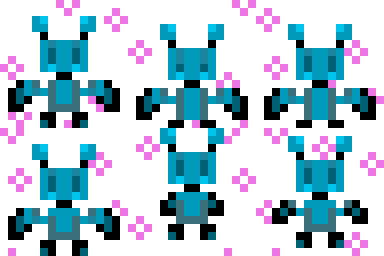
I have always been fascinated with 'animated skins' in video games, such as clothing that emits and dims out light or artwork that moves. For this reason I decided to include particles in Enyo's design to display his power or rather, the current mode he is in currently. Mode Concept ExplanationThe concept for Enyo's modes elaborate from the final concept displayed above, changing the primary color of the body, the color of the particles that Enyo emits and the particle movement that emphasize which power Enyo is currently using. Below are the details of each form:
AnimationsBelow are the animations I made using Piskel for all modes for the following actions, idle, moving, falling, jump, damage and death. Notably, tween animations were used in Enyo's Escape as well for inverting Enyo's movement when going leftward.
Note: The original character pixel art is 16 x 16 pixels. All animations have been slowed down and upscaled from the game for better viewing. TilesheetBelow is the tilesheet the game uses for the character Enyo that I created using all of the animations above. 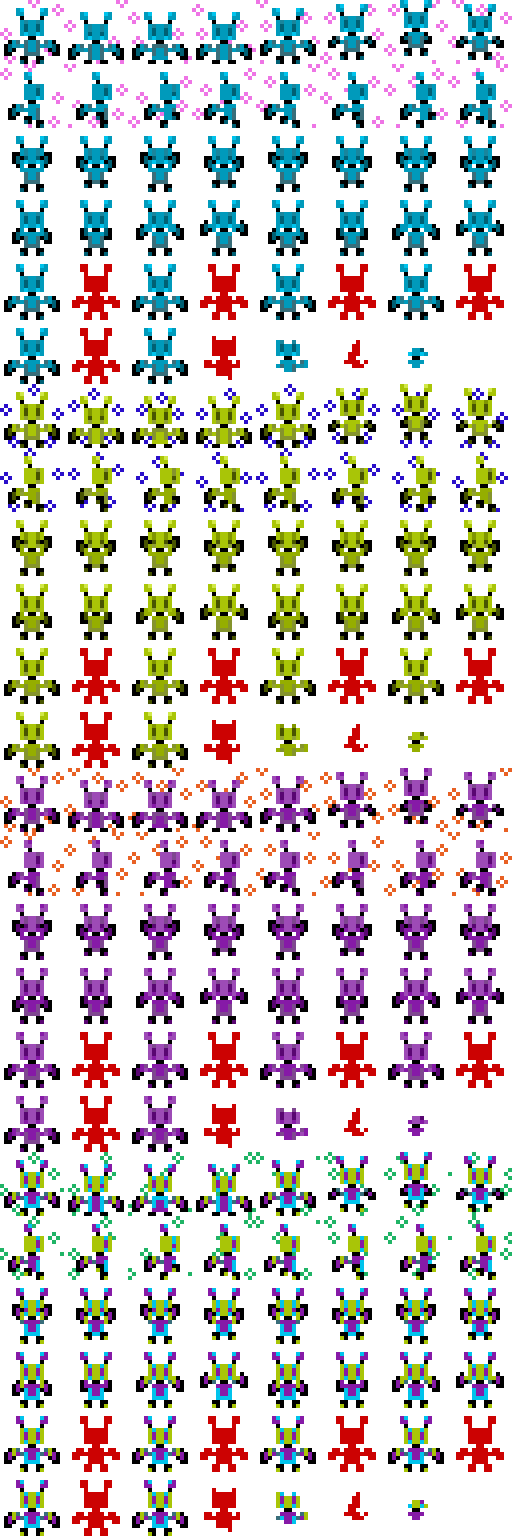
Note: This tilesheet includes the animations for the 'Zen' mode that is unlocked after beating the game. More about this mode is spoken of below. Secret Mode Concept Art & Animations (Artwork)Showcasing - Enyo Secret 'Zen' Mode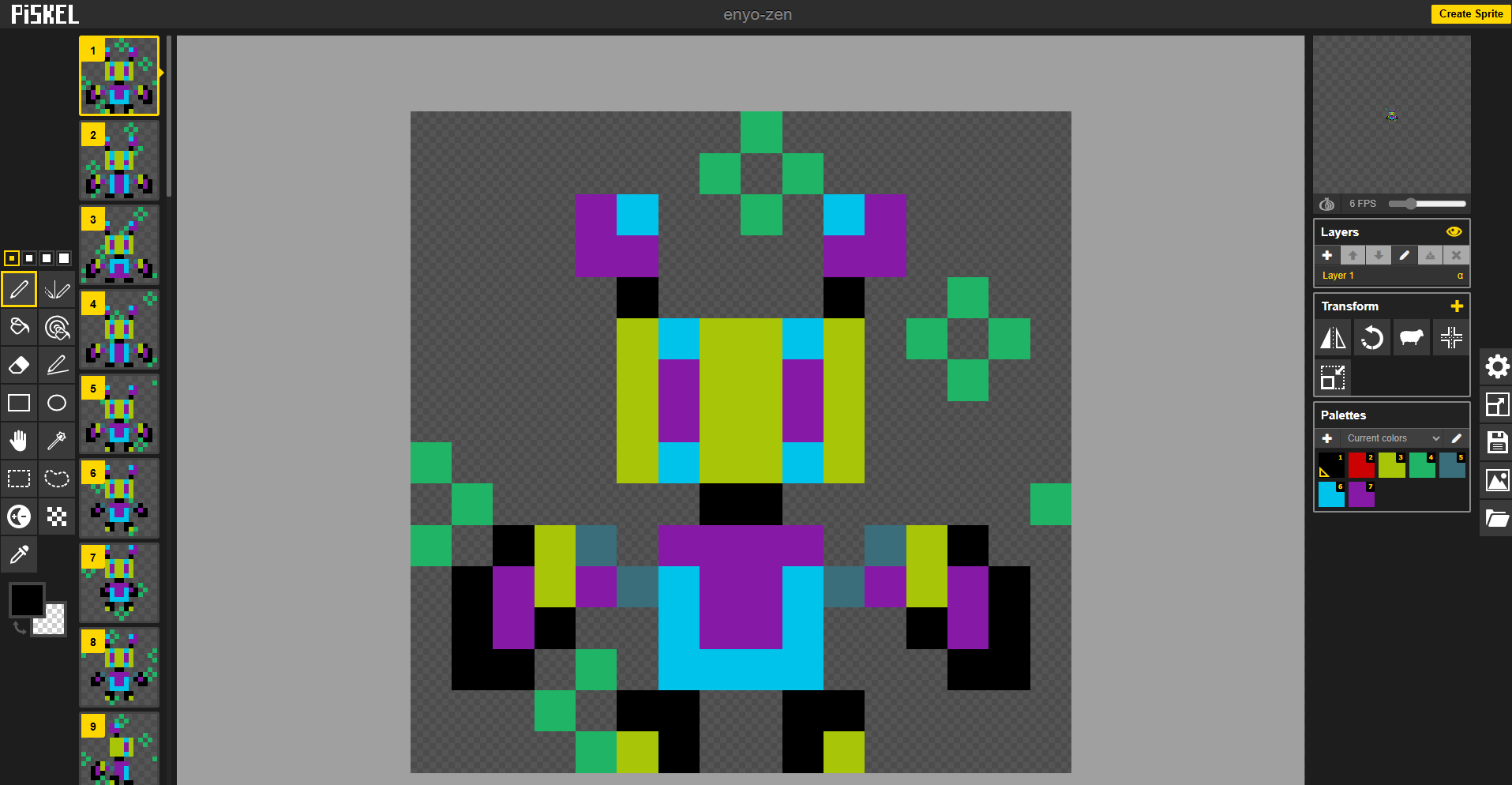
Artwork - Secret 'Zen' Mode ConceptMotiveAs will be spoken of in the later Play Testing section, play testers who were able to try out an early version of the game spoke highly of the gameplay but were not satisfied with the reward factor. In order to increase replayability, I worked on a few additional game features with the inclusion of an unlockable mode for Enyo known as 'Zen' mode that holds the characteristics of all modes at once. Concept ExplanationThe concept for 'Zen' mode is similar to the final concept listed in the Enyo Concept Art & Animations subsection of this artwork section however, to highlight the fact that the mode contains all characteristics of every mode, I purposely did not use a main color but instead mashed together the colors of all modes into this mode.
AnimationsAll animations for 'Zen' mode are the same as the modes above for every action. As the case above, all animations have been slowed down from the game for better viewing.
Enemy Concept Art & Animations (Artwork)Showcasing - Snake Concept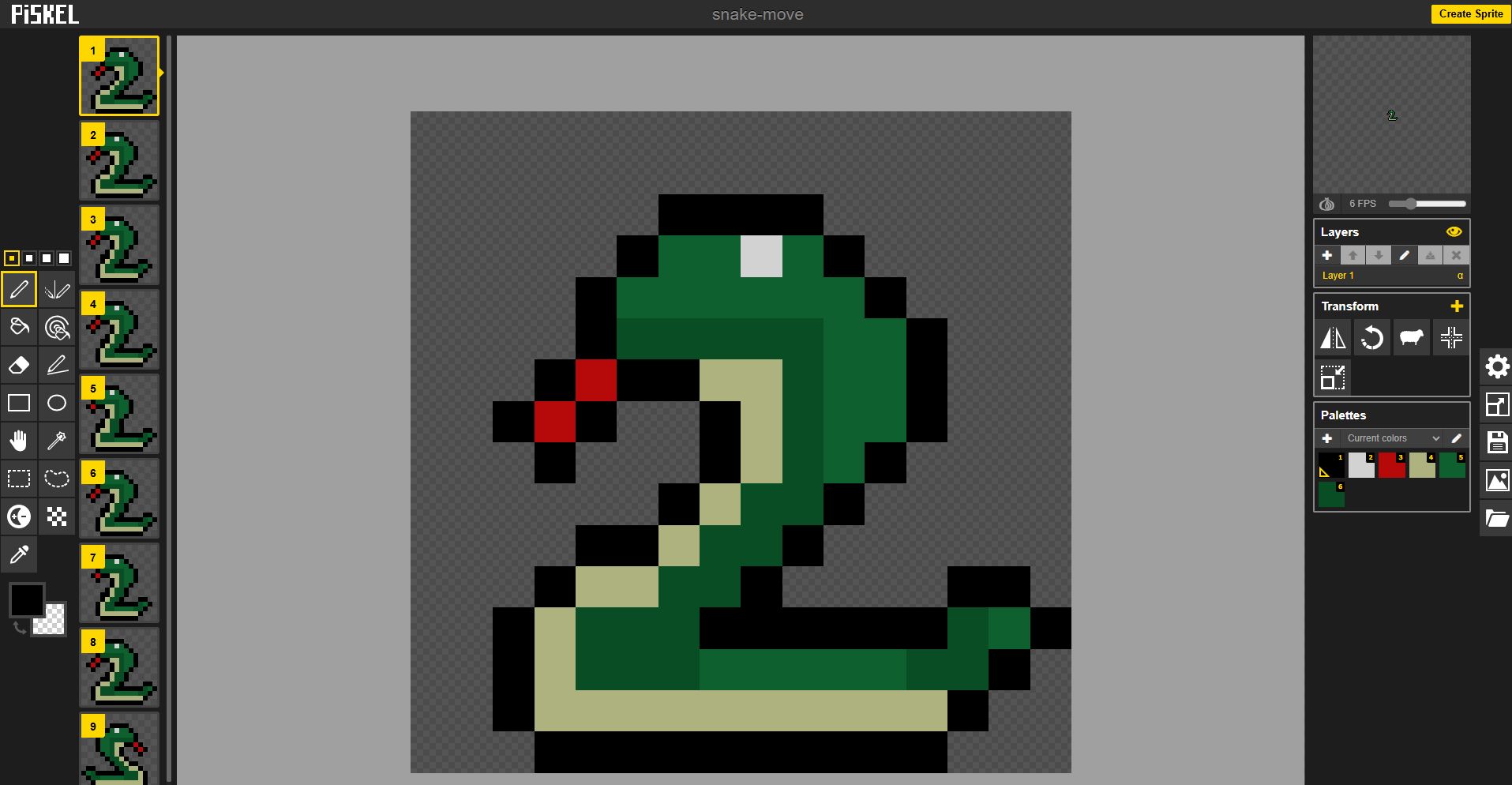
Artwork - Snake Concept (Desert Enemy)Concept Explanation (Snake)The 'snake' enemy serves as our first type of enemy. They are encountered in the first two levels of the game, specifically in the desert levels. To fit the desert theme, I contemplated between designing a scorpion or a snake but decided to create snakes as the first enemy because of the color scheme bringing more life into the game. The snake has the common green skin with a beige belly and red tounge that protracts and can be seen slithering in the desert. Animations (Snake)Below are the animations for the snake I created using Piskel. The 'death' animation is omitted as it is handled in-game with the use of tweens. Play the game and attack an enemy to check it out!
Tilesheet (Snake)Below is the tilesheet for the snake enemy I created using the animations above. 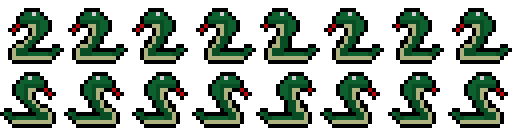
Note: There is no 'attack' animation as simple contact with an enemy deals damage. Additionally, the 'death' animation is omitted as it is handled in-game with the use of tweens. Play the game and attack an enemy to check it out! Showcasing - Scientist Concept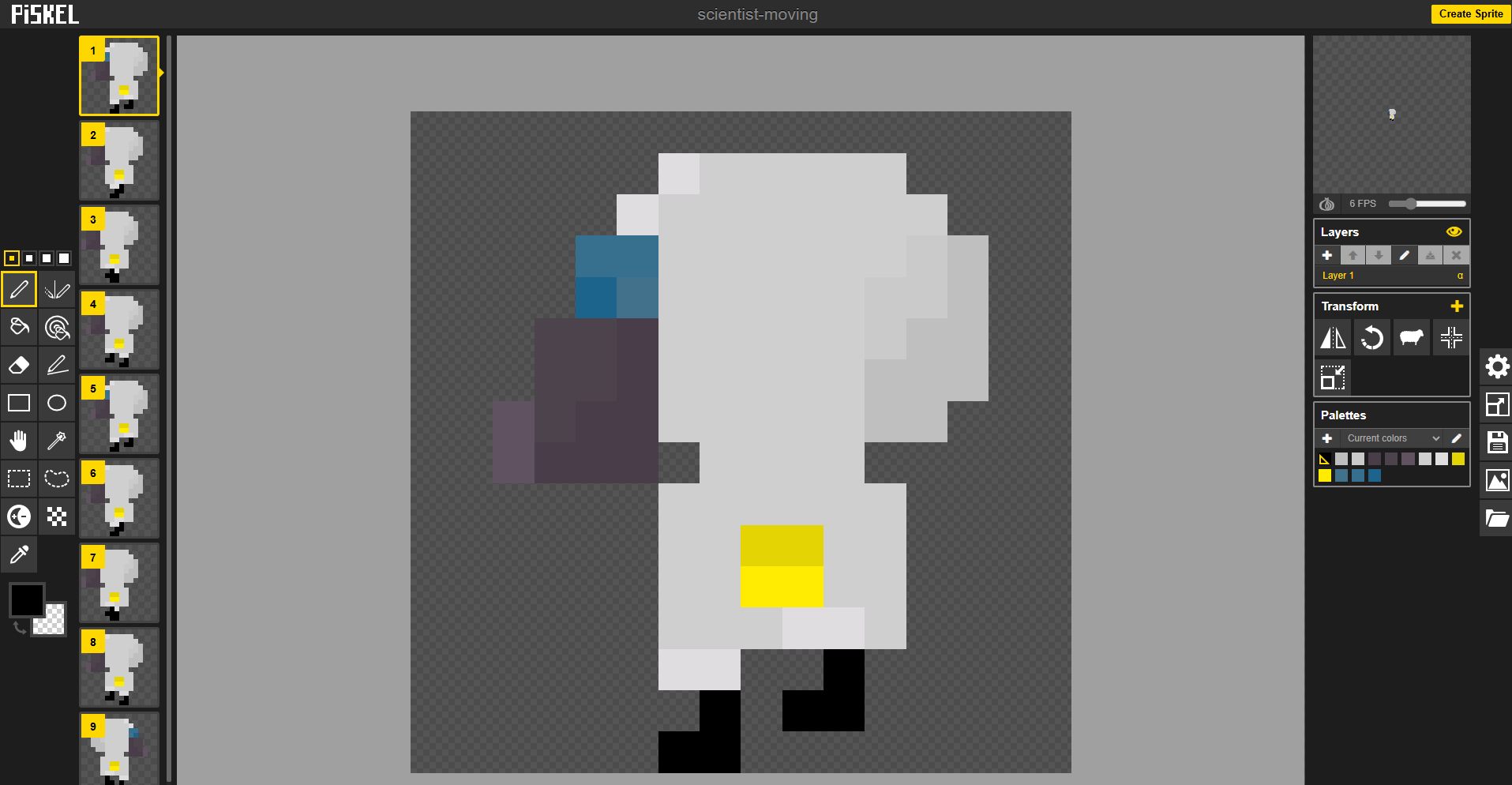
Artwork - Scientist Concept (Lab Enemy)Concept Explanation (Scientist)The 'scientist' enemy serves as our second type of enemy. They are encountered in the middle two levels of the game, specifically in the lab levels. To fit the lab theme, I contemplated between designing a scientist or an alien but decided to create scientists as the enemy because the use of aliens could be used in the final levels of the game that centers around a space theme. The scientist has on a white lab coat, black boots, yellow gloves and a gas mask. Animations (Scientist)Below are the animations for the scientist I created using Piskel. The 'death' animation is omitted as it is handled in-game with the use of tweens. Play the game and attack an enemy to check it out!
Tilesheet (Scientist)Below is the tilesheet for the scientist enemy I created using the animations above. 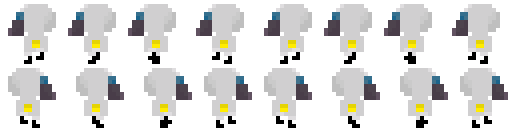
Note: There is no 'attack' animation as simple contact with an enemy deals damage. Additionally, the 'death' animation is omitted as it is handled in-game with the use of tweens. Play the game and attack an enemy to check it out! Showcasing - Alien Concept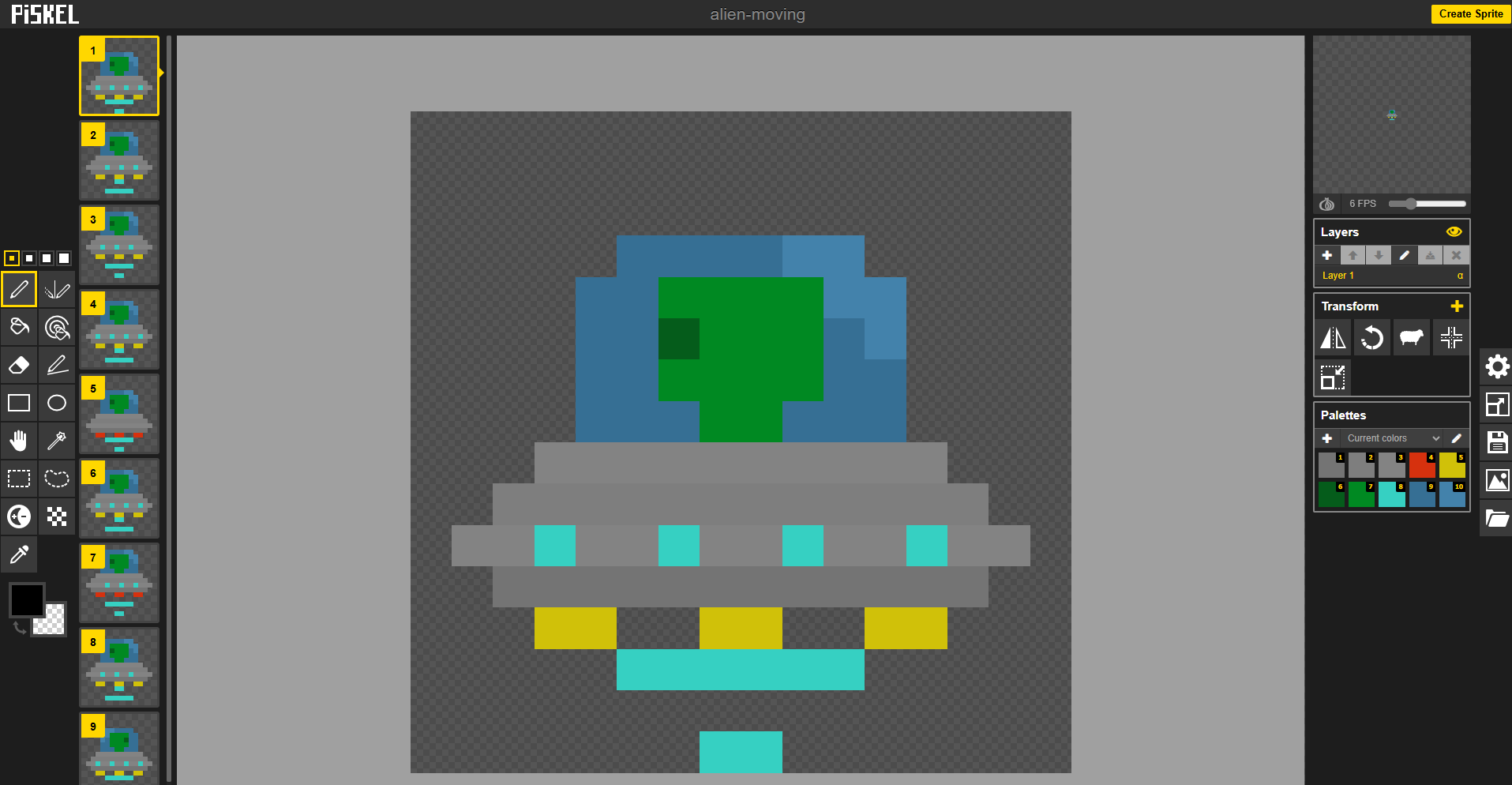
Artwork - Alien Concept (Space Enemy)Concept Explanation (Alien)The 'alien' enemy serves as our third and final type of enemy. They are encountered in the last two levels of the game, specifically in the space levels. To fit the space theme, I contemplated between designing an alien or simple meteors but decided to create aliens as the enemy as they could bring more platforming to the game through floating around if created using 'spaceships'. The alien is green and is inside a spaceship that lights up and hovers around, gradually moving in any one-way direction. These enemies bounce off of walls and ceilings. Animations (Alien)Below are the animations for the alien I created using Piskel. The 'death' animation is omitted as it is handled in-game with the use of tweens. Play the game and attack an enemy to check it out!
Tilesheet (Alien)Below is the tilesheet for the alien enemy I created using the animations above. 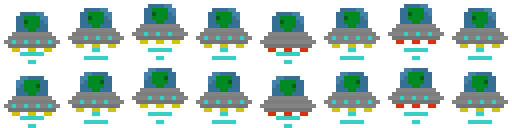
Note: There is no 'attack' animation as simple contact with an enemy deals damage. Additionally, the 'death' animation is omitted as it is handled in-game with the use of tweens. Play the game and attack an enemy to check it out! Desert Level Art (Artwork)Showcasing - Desert Level Concept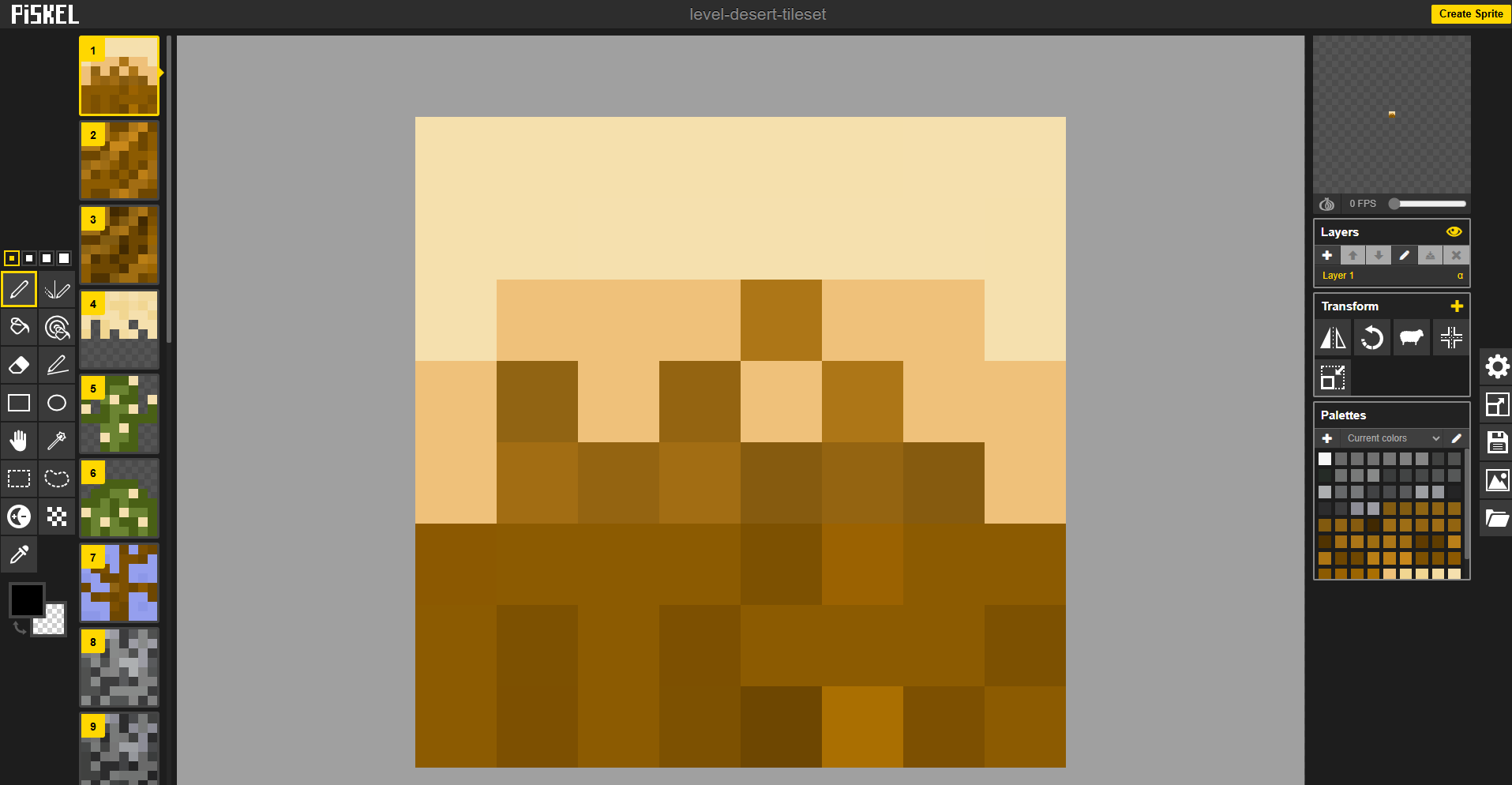
Artwork - Desert Level Concept (Tilesheet)Concept ExplanationThe concept for the first two levels were to be centered around the 'desert' theme. This desert has a sky that is a dull blue filled with off white clouds, the pavement is a dull brown soil with a bit of sand and has cactus and branches scattered across. Some additional artwork I added was the use of signs in order to help the player understand which mode they should be using to traverse the level at the point the sign is encountered. TilesheetBelow is the tilesheet for the desert level I created using Piskel. It is the smallest of the level tilesets. I desired to gradually expand on my ambition for the artwork as the levels go up in order to work on all of the modes and enemies and allocate more time to working on the sound of the game, level design and programming of the game. 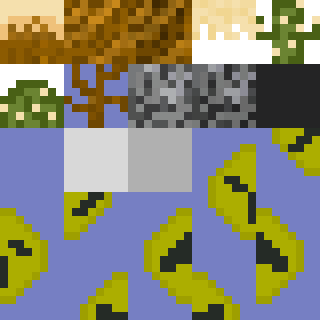
Note: The original tiles in the tilesheets are 8 x 8 pixels. All tilesheets have been upscaled for better viewing. Lab Level Art (Artwork)Showcasing - Lab Level Concept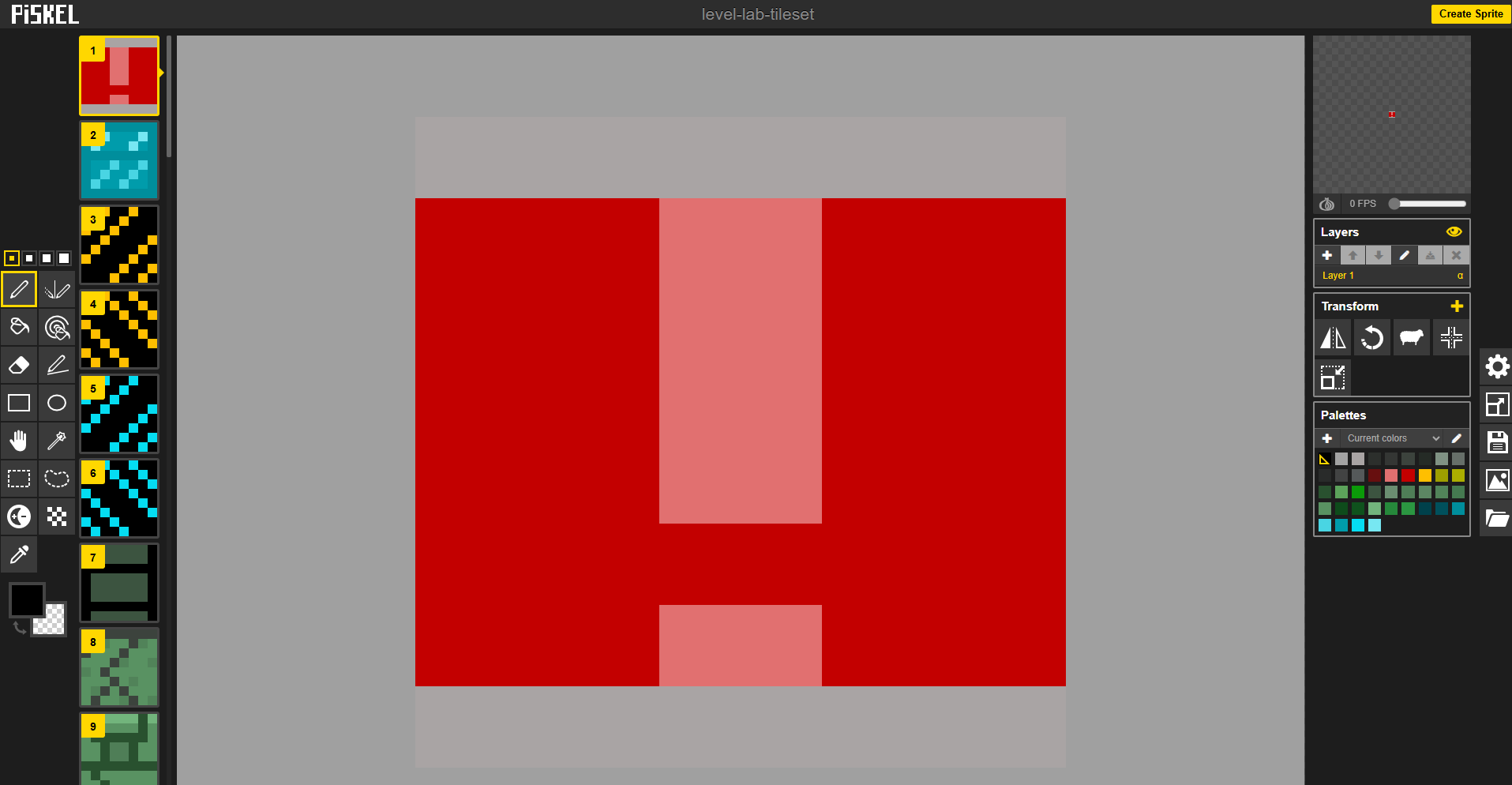
Artwork - Lab Level Concept (Tilesheet)Concept ExplanationThe concept for the middle two levels were to be centered around the 'lab' theme. This lab has a dull green background that is filled with pipes of two different colors (dark gray and light green) to give more contrast to the level, some ladders and some windows. The pavement is green tiles with the bottom underneath these tiles, set to be dark tiles of stripes and dots for added contrast. It is filled with desks that can contain testubes, beakers, monitors or a chasis, and can be mixed and matched with desks that optionally contain one, two or no chairs. Lying on the ground are alien eggs being incubated for testing and the level contains switch doors with switches. The green switch can be pressed by any mode, but the purple one can only be pressed with the 'heavy' mode. Finally, the end of level 4 contains Enyo's spaceship that is needed in order to travel back to the stars. TilesheetBelow is the tilesheet for the lab level I created using Piskel. It is much larger than the desert tileset as I wanted to really nail the concept of a mysterious lab where scientists pose a threat to aliens, making Enyo's situation feel more hopeless. 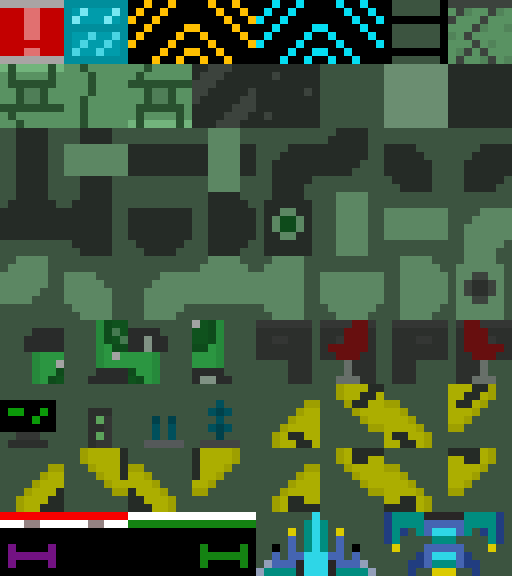
Note: The original tiles in the tilesheets are 8 x 8 pixels. All tilesheets have been upscaled for better viewing. Space Level Art (Artwork)Showcasing - Space Level Concept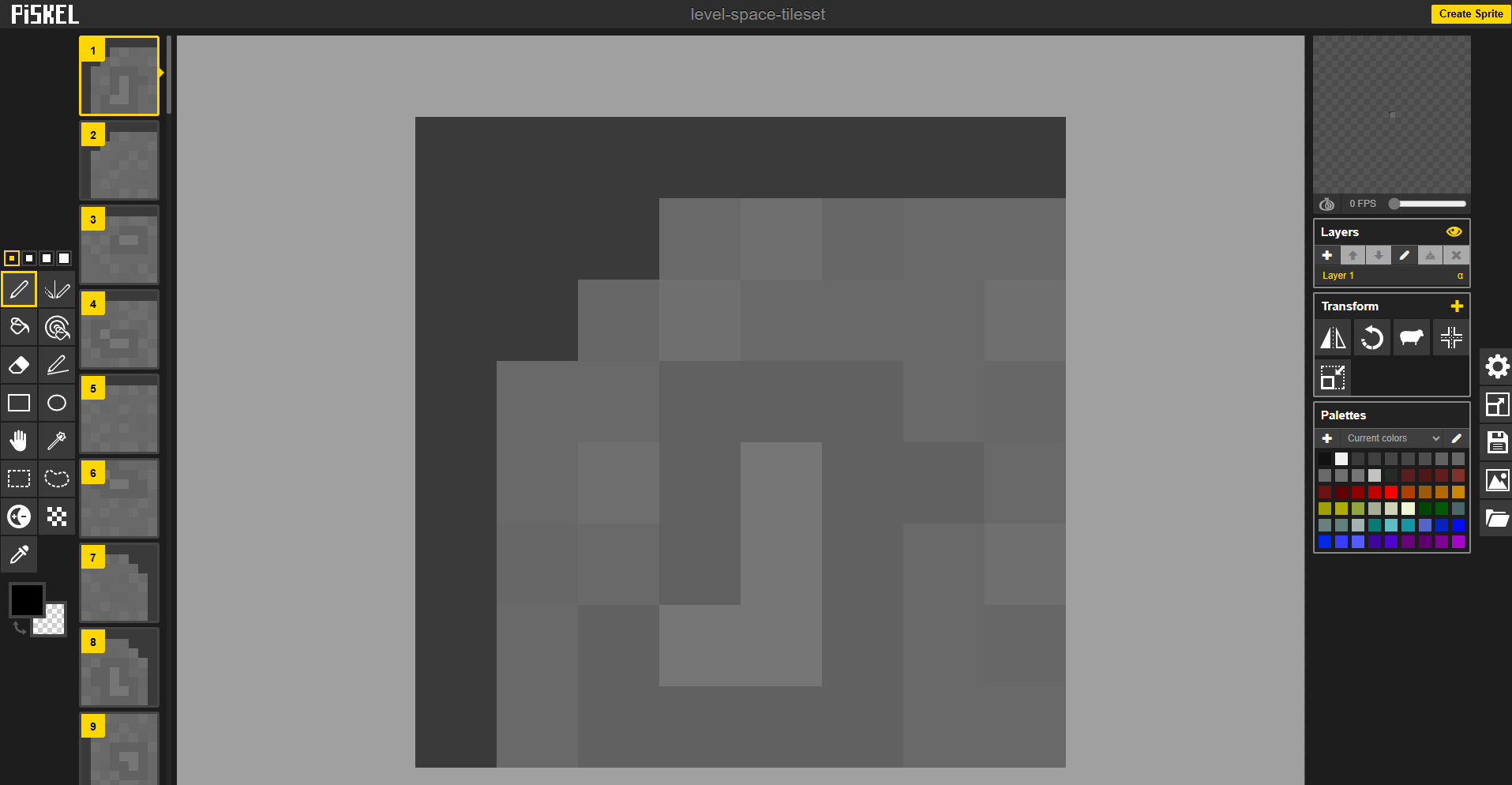
Artwork - Space Level Concept (Tilesheet)Concept ExplanationThe concept for the last two levels were to be centered around the 'space' or 'galaxy' theme that was popular in the 2d-era when Galactica was king. I designed this tileset to be modular in mixing and matching sets of pavements that in this level are detailed comet ground, with craters beneath them, stars that consists of 3 main colors (light blue, dark orange, and dark yellow), 3 large planets consisting of 4 individual 8x8 tiles creating a tile of 16 x 16 pixels each (red, green and royal blue with a ring), 2 smaller planets (orange and purple), and 1 individial dull blue medium planet with a ring of 16 x 8 pixels. In the background of each space level there is a lining of a large comet to give the depiction of how large space is in contrast to Enyo through the size of a comet. My favorite addition to these levels are the purple supernovas that I created using 2 sets of 4 individual 8 x 8 tiles, stacked one after another diagonally to give the appearance of an infinitely large supernova across the stars. Another favorite of mine was the inclusion of the warp tiles that are also 4 sets of 8 x 8 tiles, the blue one is found at the end of the game while the white one is used to teleport to the secret level and are found in the secret level as a means of transportation. To conclude, the space levels contain new type of tiles, the insta-kill lava tiles and teleport tiles. Other tiles with the same functionality of crumble are found as well but have new designs to fit the theme of space. TilesheetBelow is the tilesheet for the space level I created using Piskel. It is the largest of the tilesets and the theme that I looked forward to designing the most. As I have always been fascinated with the universe as a whole, I had a deep desire to create a design that would personify the simple beauty of the stars through the nastalgic 2d pixel style. This larger tileset was created with that desire. 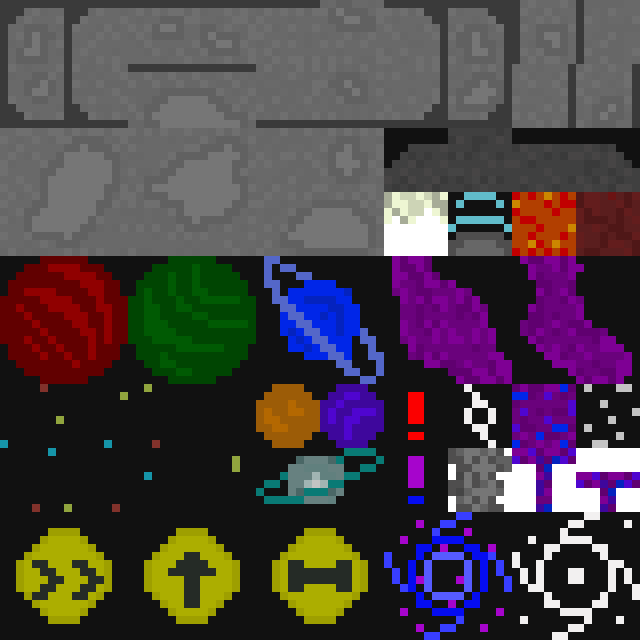
Note: The original tiles in the tilesheets are 8 x 8 pixels. All tilesheets have been upscaled for better viewing. UI Modes & Healthbar Icons (Artwork)Showcasing - Zen UI Icon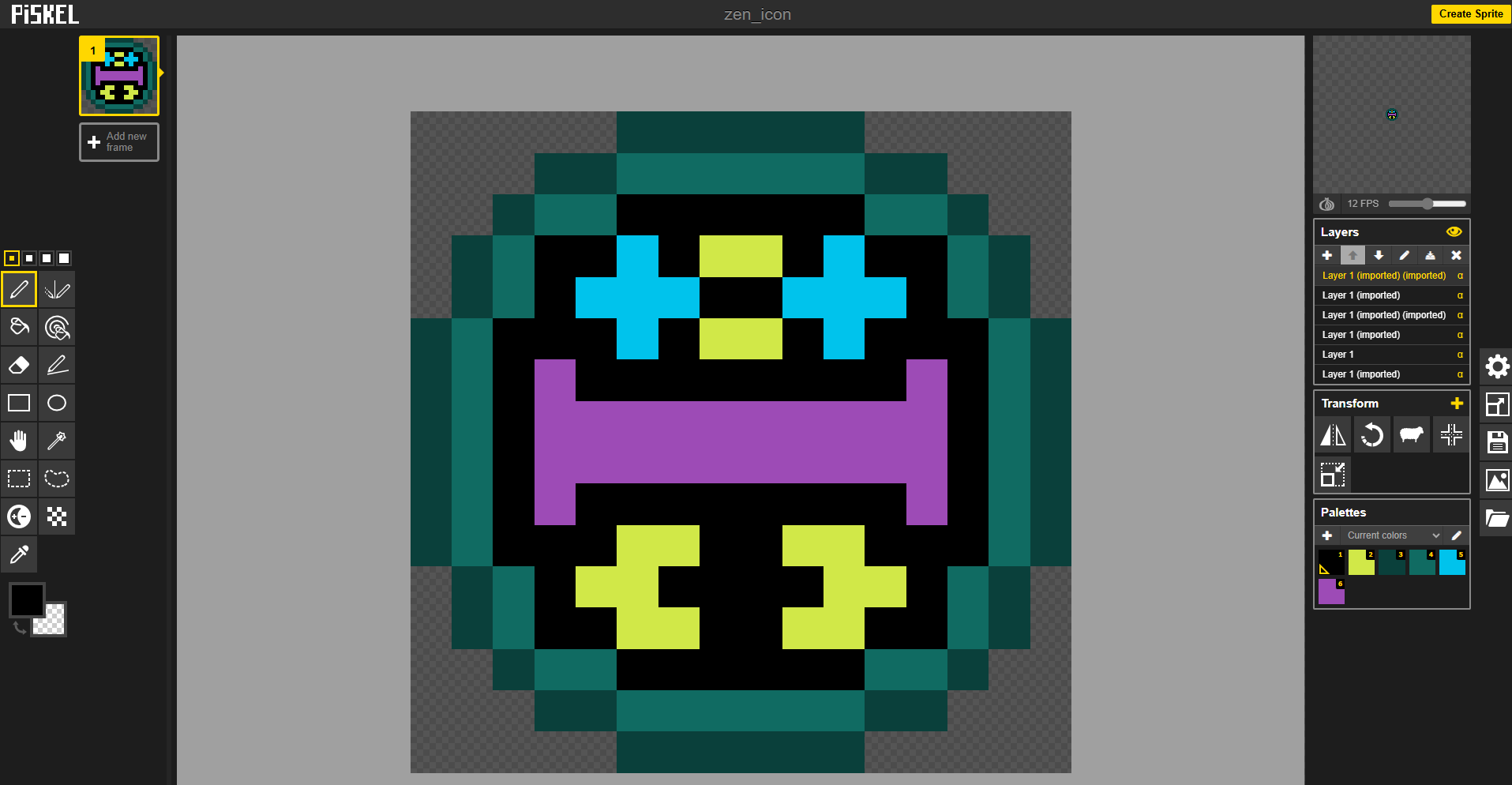
Artwork - Zen UI Icon (Last Icon Worked On)Concept ExplanationThe UI artwork were the last things I worked on regarding artwork for Enyo's Escape after the character and level tilesheets were finalized. For the UI, there are two main types of icons that are used, one to display the health currently remaining on Enyo that range from the colors green, yellow, orange and red, while the other icon displays the current mode Enyo is in. Before the game programming competition commenced, I included an additional mode icon for the 'Zen' mode. It takes inspiration from the previous icons, using the main color of each mode and their main indicator (i.e., a purple dumbell for 'heavy'). Below are all UI Icons seen in the game.
Note: The 'Zen' mode icon uses the primary color scheme of the deprecated 'default' mode of Enyo that was discussed in Enyo Concept Art & Animations. This was a nice homage to a mode that was not used in the final version of the game. Contribution: SoundOverview (Sound)Showcasing - Audacity Website
Sound - Audacity UI (Downloading Software)ExplanationIn this subsection I briefly go over the following sound I implemented for Enyo's Escape: Initially my role with working on the music and sound for Enyo's Escape began with designing a theme for the space level. After doing so I came to the realization that I enjoyed the act of composing sounds to create the music for a specific theme, and so I insisted I work on the sound for Enyo's Escape. Main Technologies (Sound)Showcasing - Chiptone Website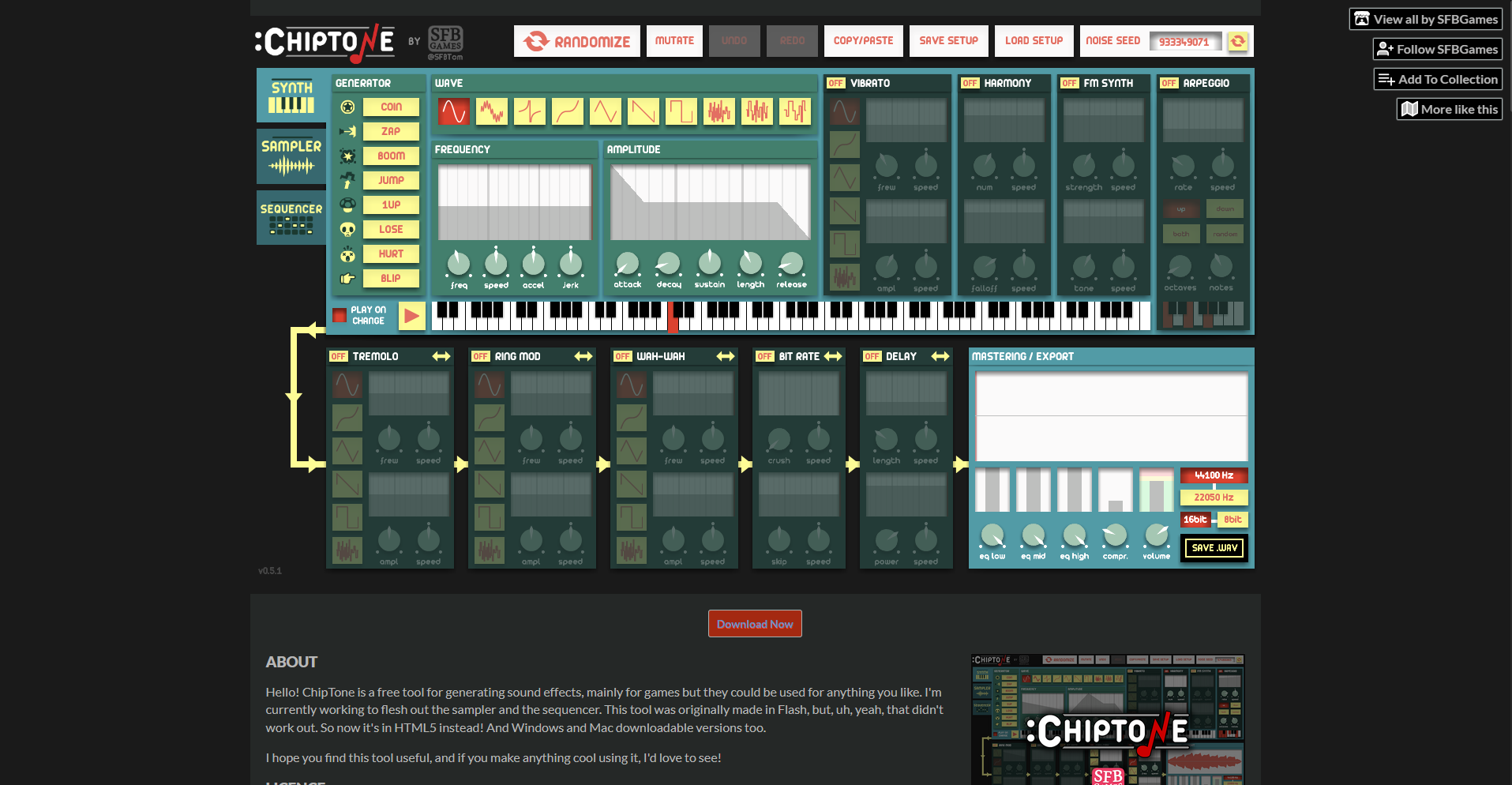
Sound - Chiptone Website (Downloading Software)ChiptoneChiptone was used for creating every individual .wav file in Enyo's Escape with the exception of the main theme Some of these .wav files were edited in Chiptone and finalized then used in the game as-is. Chiptone uses a keyboard for manipulating the key note the sound clip uses and knobs on the bottom for additional effects if desired. For the level music of the desert theme, lab theme and space theme another technology needed to be used. AudacityAudacity was used to take individual .wav sound files to compose them into level music for all three game themes of desert, lab and space. Specifically, this software allowed me to normalize sound as I added and merged sound files together as well as time sound files accurately when making melodies. Online SequencerOnline Sequencer was used soley to create a piano theme as the main theme for Enyo's Escape. Pieces composed on the software can use a range of instruments as well as take on a variety of effects. I decided to use the piano specifically for the purpose of creating a music box melody in the key of C minor as this key is known for being melancholic and is often associated with sadness. Main Theme (Sound)Showcasing - Main Theme Melody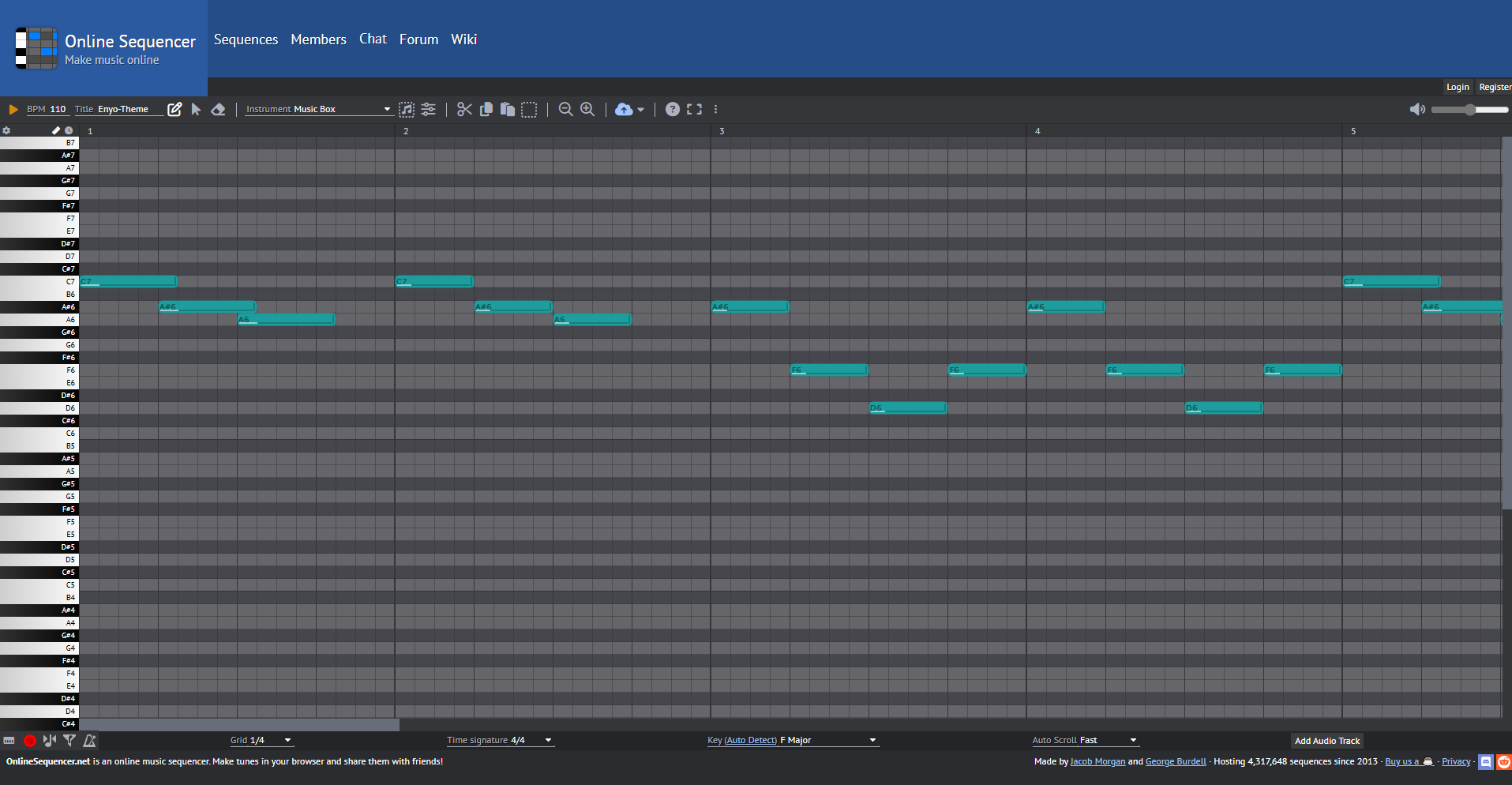
Sound - Main Theme (Online Sequencer)Concept ExplanationOriginally, there was no plan to create a main theme for the game but that was changed when Enyo's Escape made it as a 2024 Finalist at the 2024 Stony Brook University Annual Game Programming Competition. This theme is the first and only audio that was not created using Chiptone, but rather an online application known as Online Sequencer. I decided to go with a simple piano using the musicbox effect to convey the bittersweet feeling a journey such as what the main character Enyo faces must feel like. For this reason, I used the C minor scale as it is known to envoke sadness. SampleBelow is a sample of what the main theme sounds like. This theme plays during both the game trailer and the Secret Level. It was created using Online Sequencer. Desert Theme (Sound)Showcasing - Desert Level Theme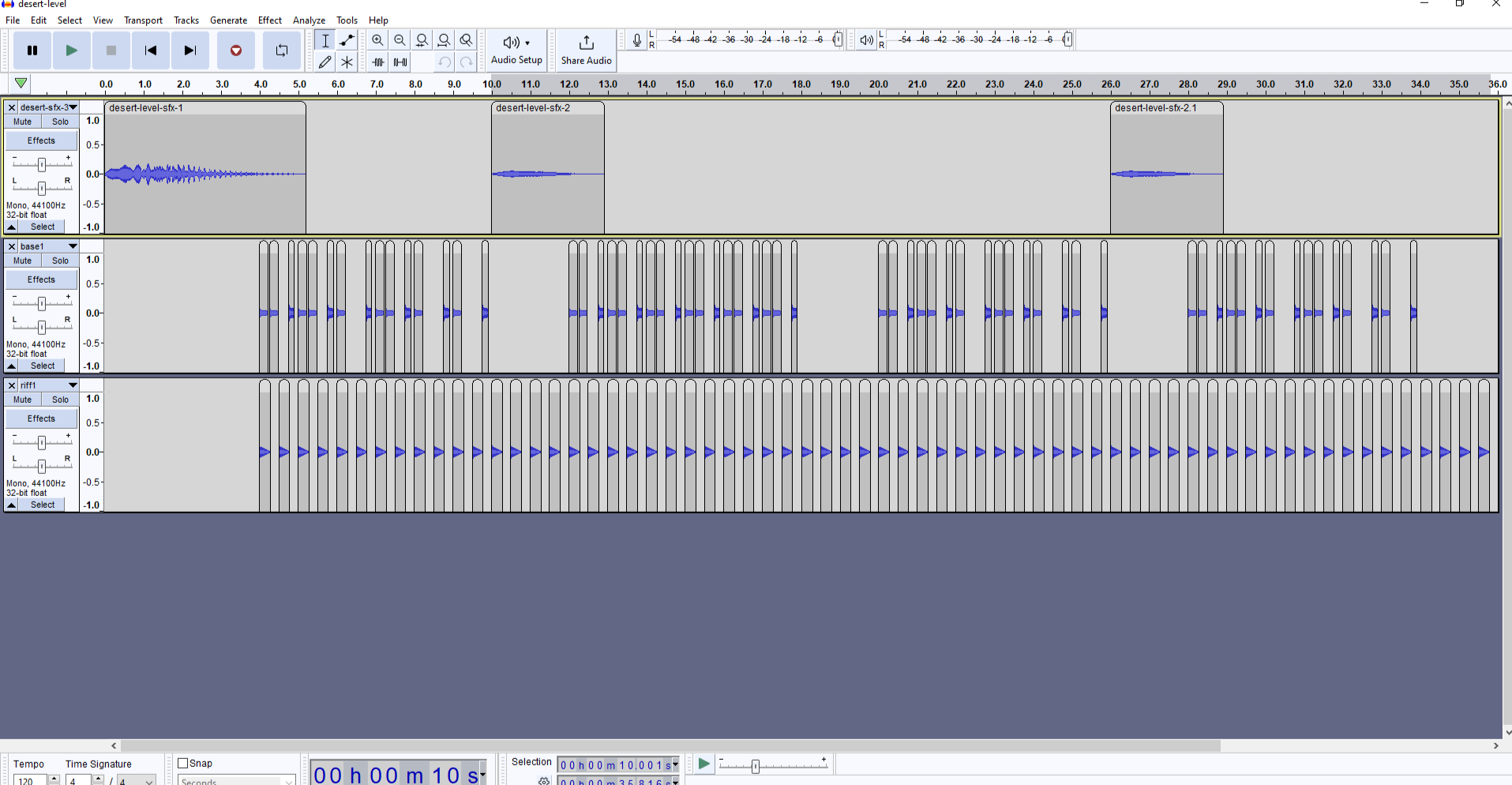
Sound - Desert Level Theme (Composing In Audacity)Concept ExplanationAs the first stage the player encounters upon entering the game is centered around the 'desert' theme, I decided to capitalize on the empty and arguably lonely nature of the desert to create another melancholic theme using the C minor scale. This theme features a loud beat (beginning at 0:03) to convey to the player that this journey has begun and a main melody (also beginning at 0:03) that uses the C minor scale. The theme also uses sound effects to enhance the theme such as a distorted 'hollowing out' sound that creates a sense of anxiety from 0:00 - 0:03. Another sound effect used is the hiss of a snake at 0:10 and 0:25 to remind the player that there is no life in this desert beside snakes and Enyo himself. SampleBelow is a sample of what the desert theme sounds like. This theme plays during the first two stages of the game. It was created using Chiptone for generating and manipulating sound (waveform audio files or .wav files) and Audacity for taking said files and creating compositions. Lab Theme (Sound)Showcasing - Lab Level Theme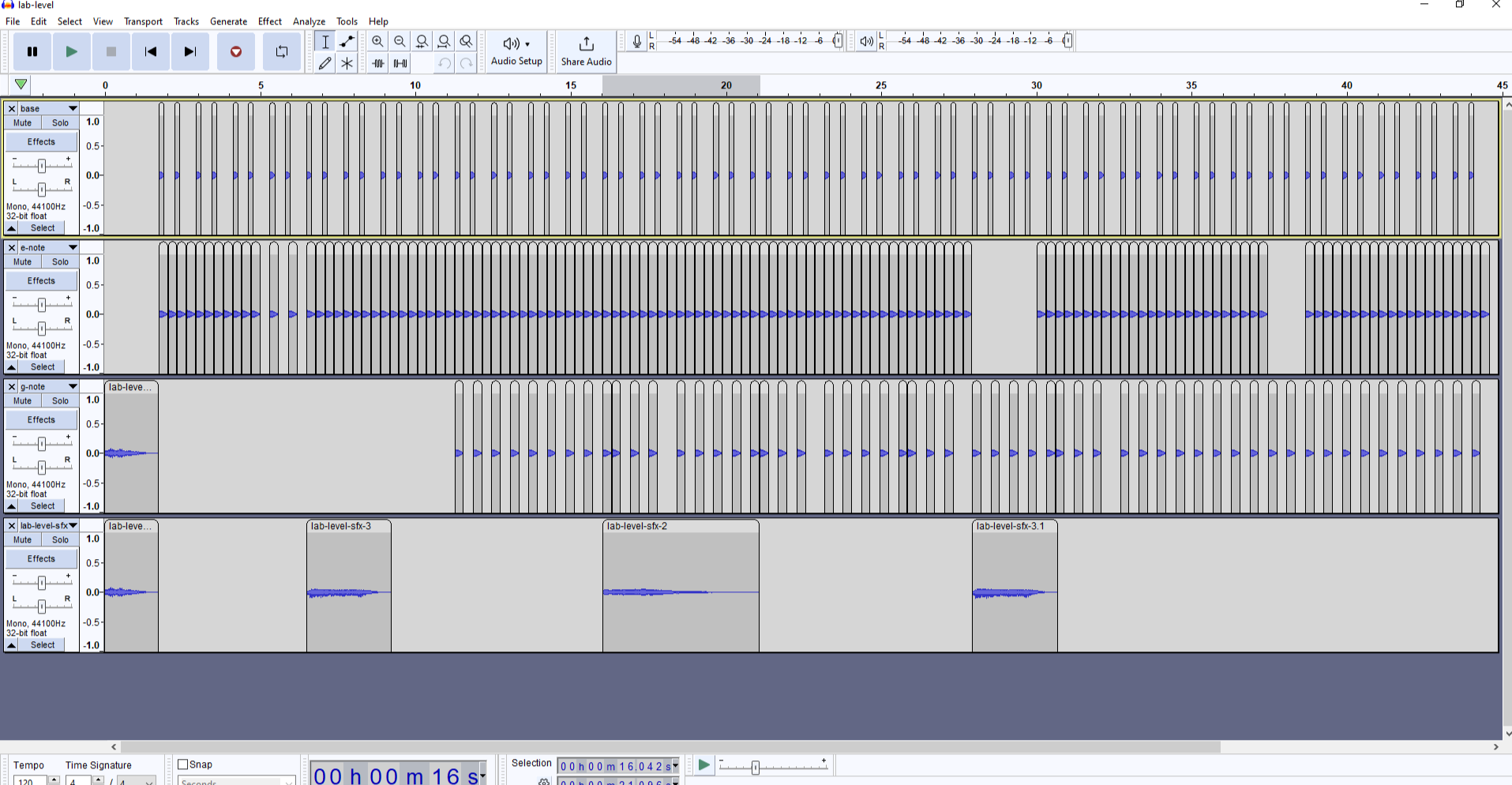
Sound - Lab Level Theme (Composing In Audacity)Concept ExplanationFor the 'lab' theme, I decided to create a more energetic beat that creates a sense of urgency and anxiety. I did so to establish the context that is Enyo's current situation. Enyo has found a scientific base that conducts experimentation on alien life forms (exactly what Enyo is on Earth) and Enyo must traverse the lab to find his ship. The theme uses a constant fast pased beat (beginning at 0:06) that uses notes that sound like an alarm from 0:01 - 0:06 that conveys the sense of urgency and a main riff (beginning at 0:11) that conveys the sense of anxiety like time is limited. The theme also uses sound effects to enhance the theme such as at 0:00 that sounds like Enyo has 'fallen' deep into an underground base, 0:06 and 0:28 that sound like it could be unknown technology or life forms to Enyo and 0:16 that sounds like the cries of some life form being experimented on. SampleBelow is a sample of what the lab theme sounds like. This theme plays during the middle two stages of the game. It was created using Chiptone for generating and manipulating sound (waveform audio files or .wav files) and Audacity for taking said files and creating compositions. Space Theme (Sound)Showcasing - Space Level Theme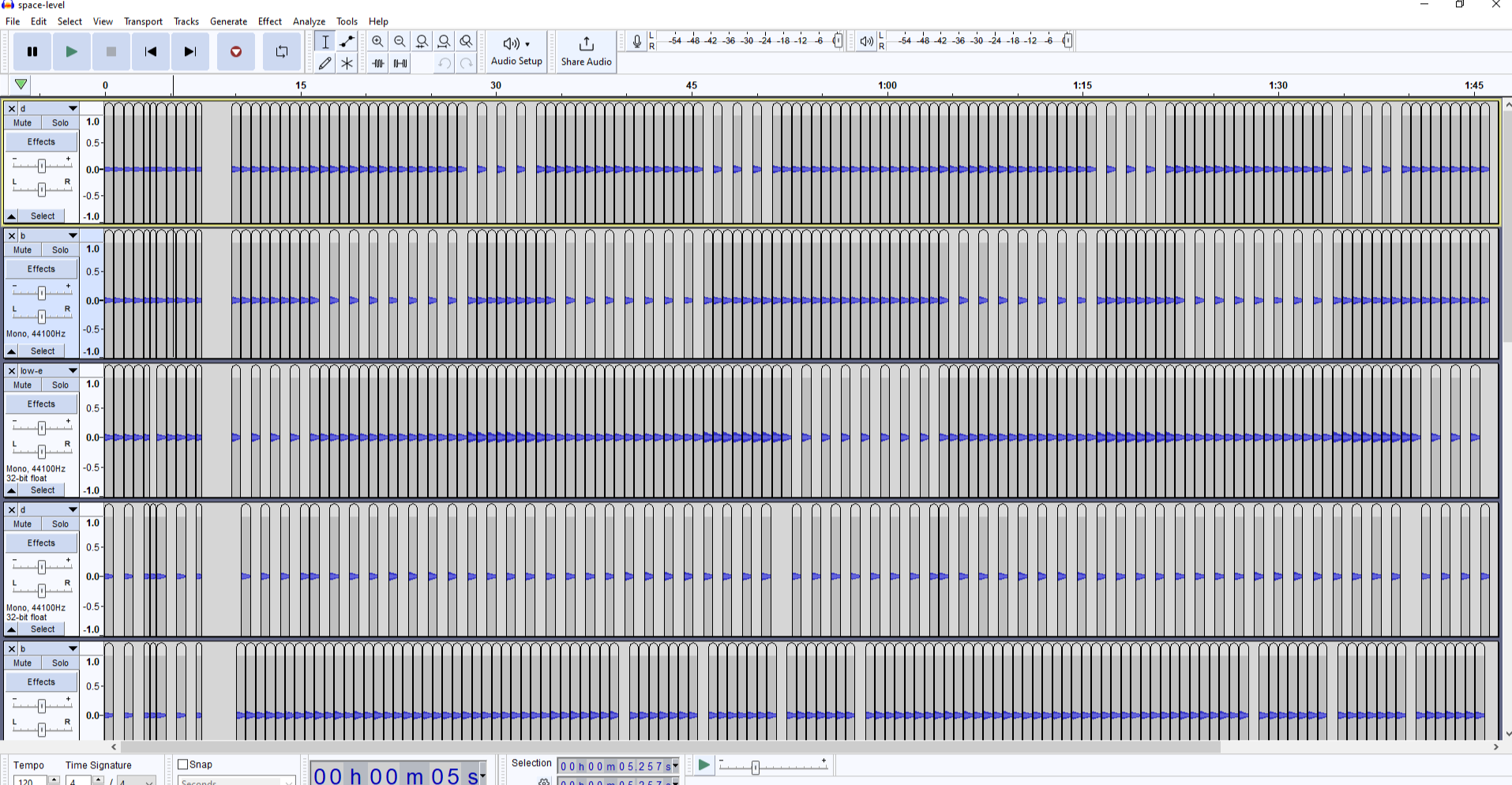
Sound - Space Level Theme (Composing In Audacity)Concept ExplanationFor the 'space' theme as with the level artwork for this level, I decided to give more time to this theme to correctly capture the feel for this level being the vacuum of space. To achieve this I decided to use 'space-like' or distorted sounds and beats as well as overlaying the main riff with another instance of the main riff to get a strange sounding composition. Unlike the previous two levels themes, the main riff begins at 0:00 in this composition and persists throughout. The base is a simple 1-2 beat with distortion. Using this, I sought to convey the feeling of the unkown of the vastness that is space in contrast to our perspective (the player). The theme also uses sound effects to enhance the theme such as the beat drop at 0:04 that sounds as if sound is being sucked into the vacuum of space, into an underground base, 0:16 and 0:46 that sound like it could be an alien spaceships distancing themselves and 0:38 that is to be an unkown sound to convey the mystery of space. SampleBelow is a sample of what the space theme sounds like. This theme plays during the final two stages of the game. It was created using Chiptone for generating and manipulating sound (waveform audio files or .wav files) and Audacity for taking said files and creating compositions. Sound Effects (Sound)ExplanationOther audio files I have worked on are listed here. These range from sounds that are specific to Enyo, sounds that are specific to enemies and sounds that are specific to tile interaction with Enyo. JumpMode ChangeZen Mode ChangeDamageEnyo DeathSnake DeathScientist DeathAlien DeathTeleportRumbleCollapseNote: These sound effects were made using Chiptone. Sounds can be made and generated using the keyboard and effect knobs located below the main keyboard. Contribution: Level DesignOverview (Level Design)ExplanationIn this subsection I briefly go over some details of the levels that I designed, specifically the motive behind the layout. My main focus was on the space set of level with the 'Secret Level' being created after the initial set of 6 levels. Below are the levels I created: More information on my contribution with the artwork for these set of levels can be found earlier in this section in the Contribution: Artwork subsection of this page. Main Technologies (Level Design)Showcasing - Tiled Website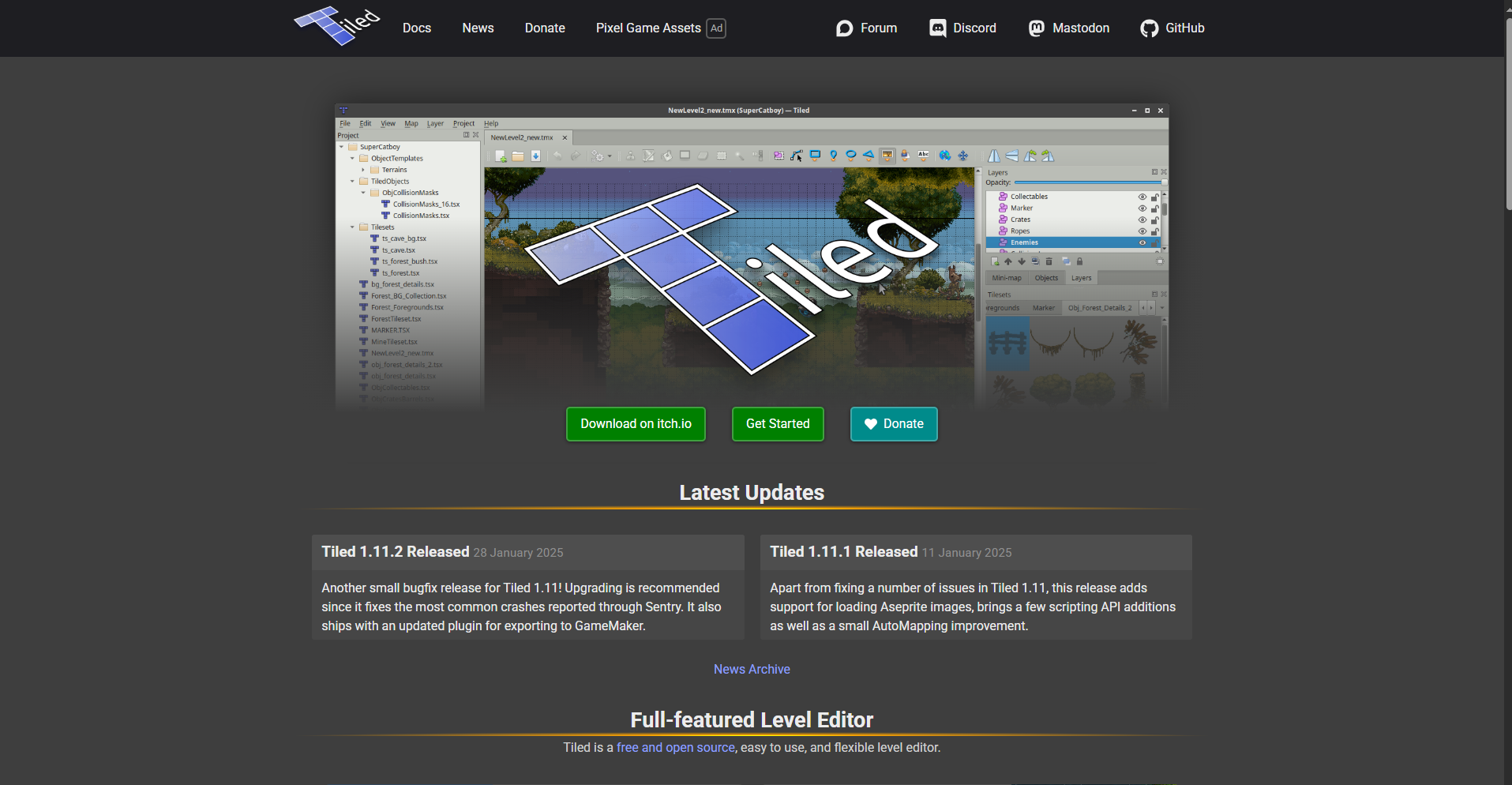
Level Design - Tiled Website (Downloading Software)TiledTiled was the main technology used for designing the levels for Enyo's Escape. As I had no prior experience with this technology, the learning curve for this software was challenging for me at first but after creating a beta level to test the fuctionality, I got the grasp of it. For the level designs, each member focused on a specific set of levels after their respective artwork had been completed. For myself, I wanted to challenge myself with designing the levels that would challenge the player the most being levels 5 and 6 and later on the 'Secret Level'. Level 5 Level Design (Level Design)Showcasing - Level 5 Design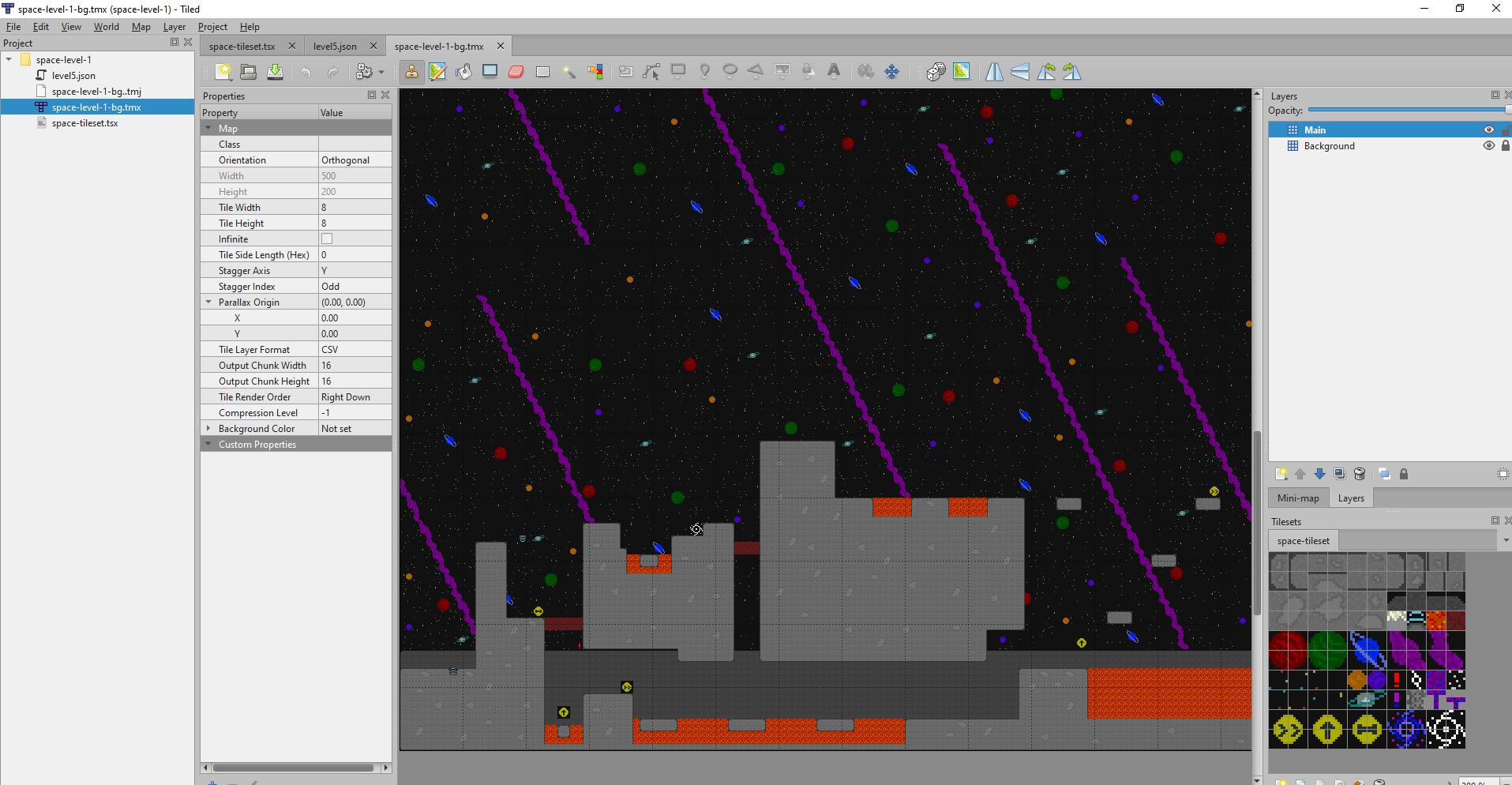
Level Design - Level 5 In Tiled (Start Of Level)ExplanationThe motive behind the layout for level 5 is to provide a challenge with required quick transitions between 'jump' mode and 'speed' mode to traverse the level. These set of space levels is where the game begins to test the player's reaction time with the introduction of the floating alien enemy as obstacles in this level. Additionally, well-timed jumps are demanded from the player in order to bridge the gap between large platforms on this level. Failure to do so would lead the player to fall into the lava pit which results in an instant game over. Shortcut ShowcaseShowcasing - Level 5 Shortcuts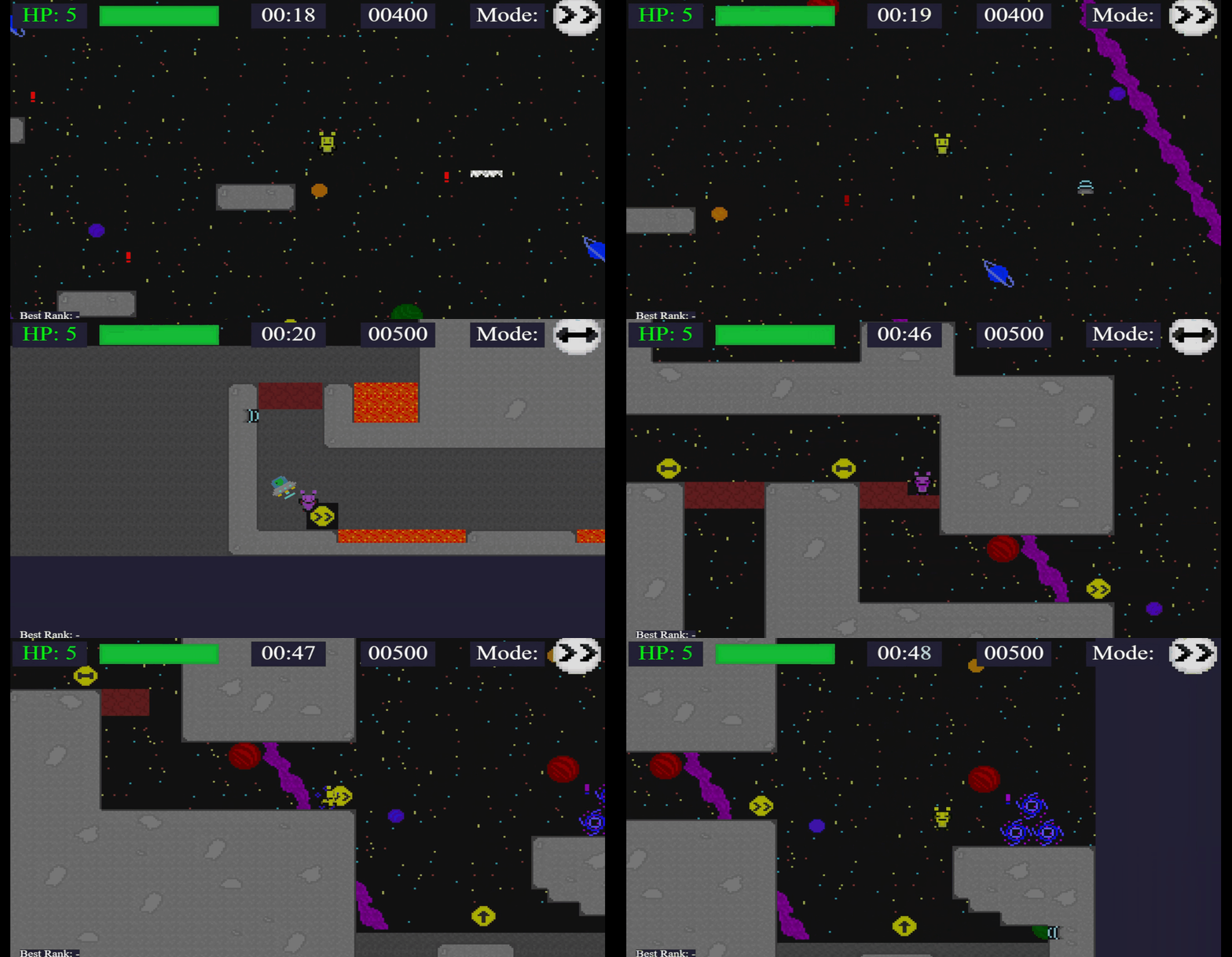
Level Design - Level 5 Shortcuts For 'S' RankThis level is where the teleport tiles and lava tiles are introduced that add more unpredictability to the platformaing gameplay. The warp tiles teleport the player to another part of the screen, specifically, the next closest teleport near them but provide no visual on the location they will be teleported. To the right we can see a brief showcase of the shortcuts available in the level that are needed to achieve an 'S' rank on this stage. Try to achieve this! Though fair warning, it's quite difficult. Note: Level 5 is the only level in which the 'Secret Level' is accessible. It is located near the beginning of the level on the meteor platform after the first lava pitfall platforming section. 'Zen' mode is needed to reach the top platform and enter the whitehole on the meteor to warp into this level. It can be seen above. Level 6 Level Design (Level Design)Showcasing - Level 6 Design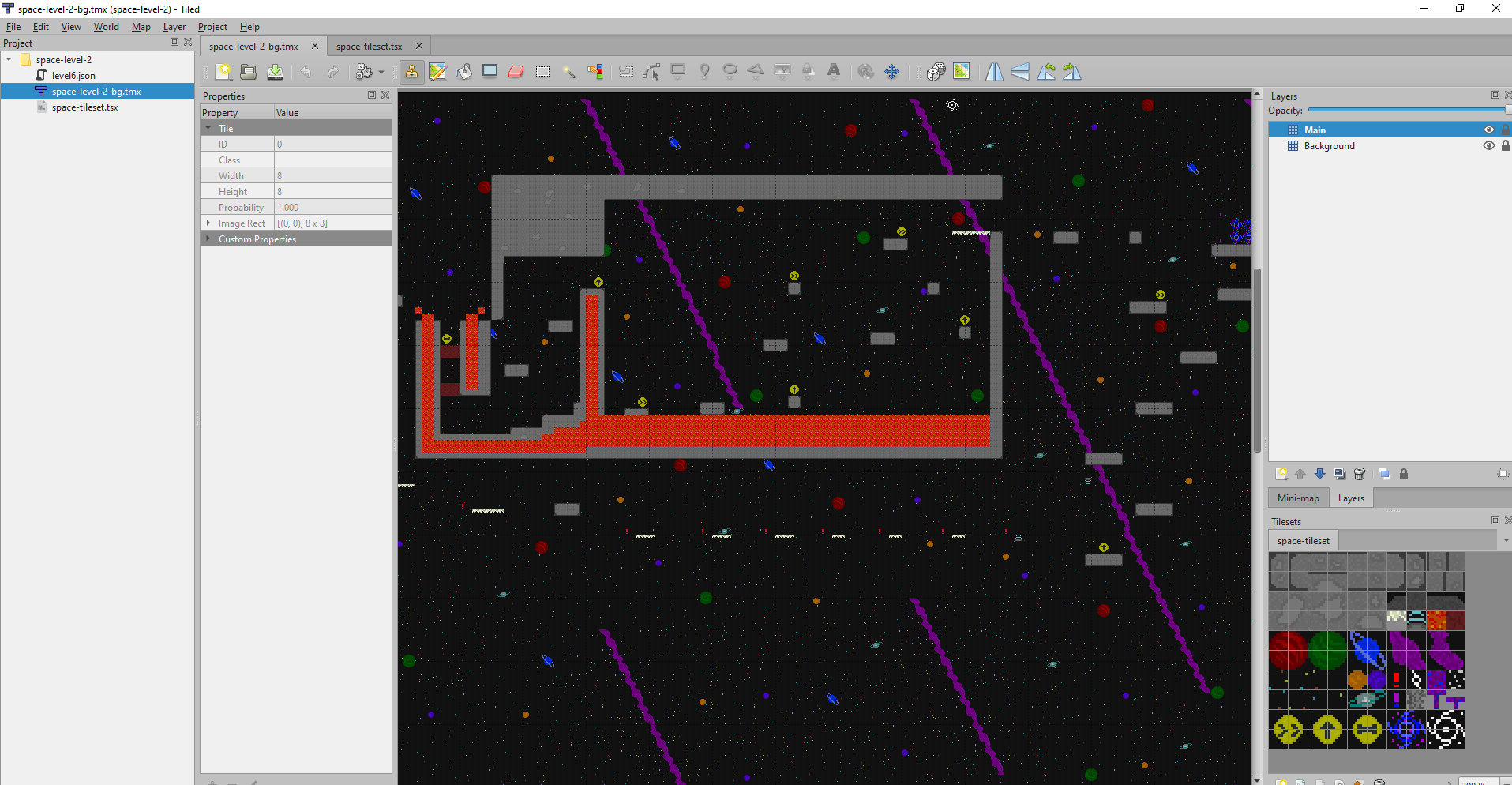
Level Design - Level 6 In Tiled (End Of Level)ExplanationThe motive behind this layout is similar to that of level 5 emphasizing the quick transition between modes however this level makes need of the 'heavy' mode in between modes to attack the large number of alien enemies found in this level. Towards the end of the level there are 2 ways one can traverse, the secret path underneath the largest meteor platform avoids the entire meteor all together and allows for achieving the 'S' rank while the top is a little less forgiving but requires perfectly timed jumps in 'jump' mode as well as well-placed attacks to traverse this meteor vertically. Shortcut ShowcaseShowcasing - Level 6 Shortcuts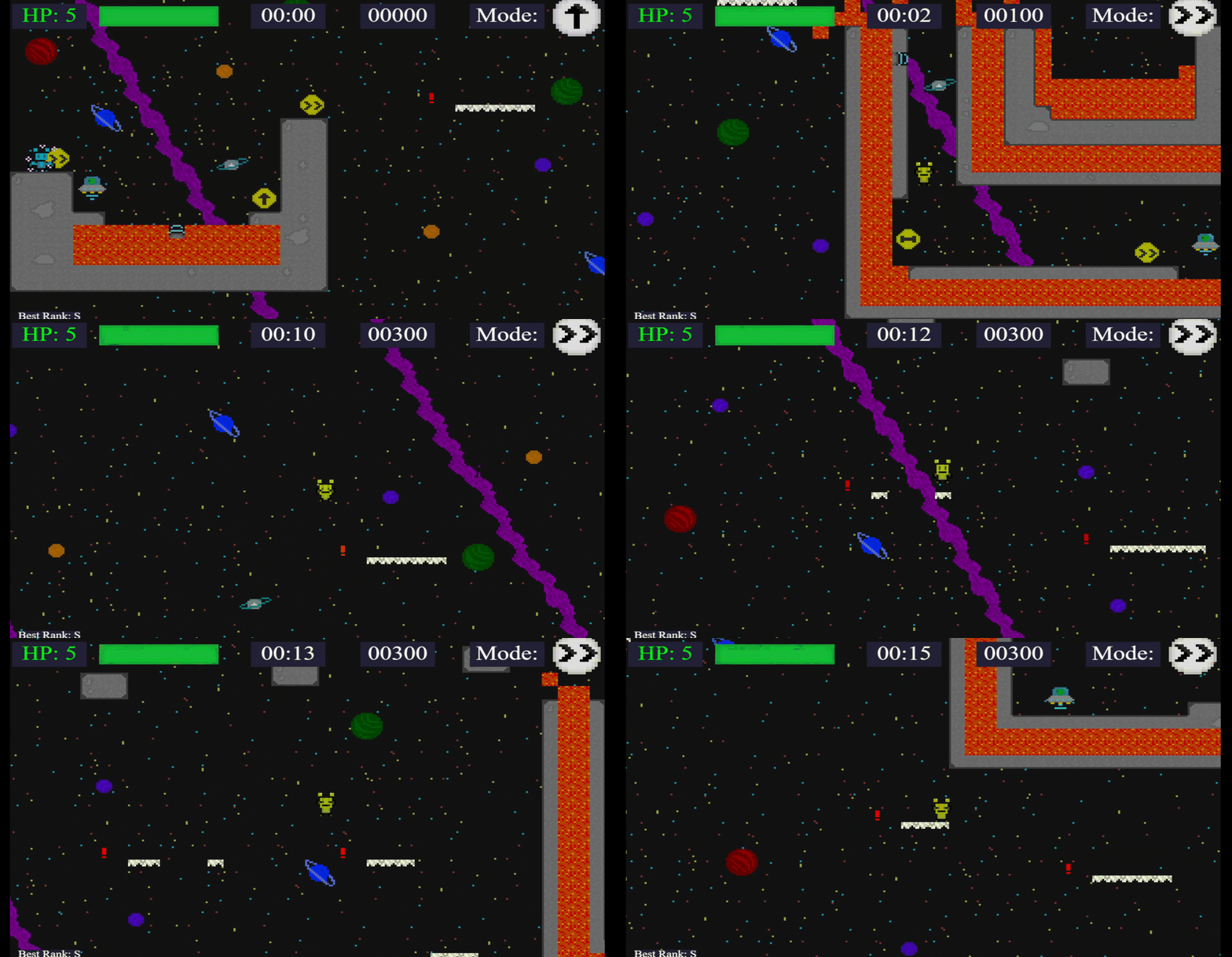
Level Design - Level 6 Shortcuts For 'S' RankAs level 6 is a space level, the teleport tiles and lava tiles are prevalent. I designed this level to be the 'hardest' in the game with the end of the level being the most difficult obstacle to overcome from levels 1 to 6. To the right we can see a brief showcase of the shortcuts available in the level that are needed to achieve an 'S' rank on this stage. Try to achieve this! Though fair warning, it's quite difficult. One final thing worth pointing out is the level skip I implemented for this level. It was designed to skip the entirety of the level as a safe measure in case the level proves too challenging to complete. Showcasing - Level Six Skip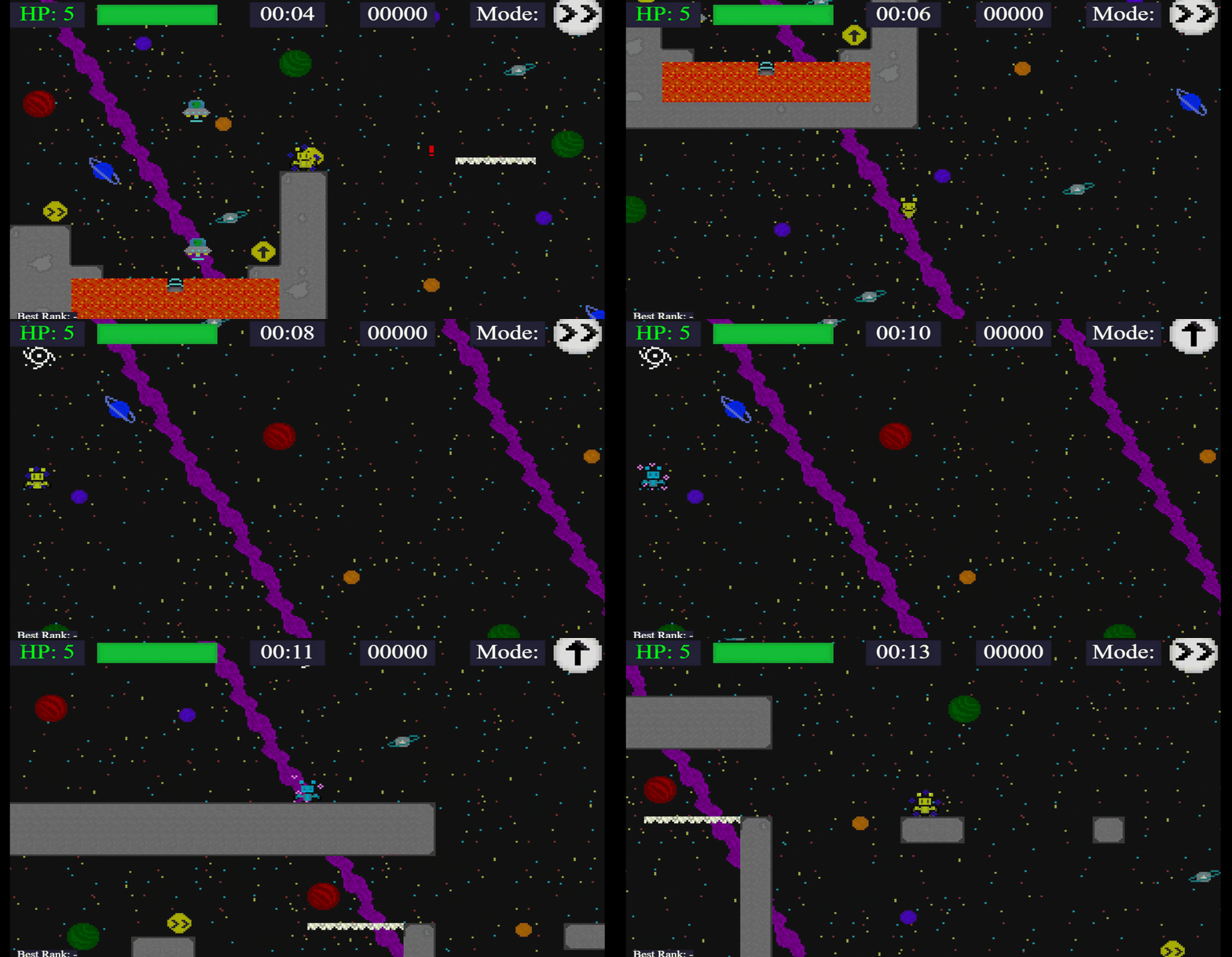
Level Design - Level Six Skip (Easy Zen Mode Unlock)Entire Level SkipIn order to skip this level, the player must walk off the edge of the starting platform after jumping past the lava and immediately begin to hug the left wall. The player will then descend past the stars and hit an invisible wall and platform. The player must then switch to 'jump' mode if not already in and jump into the whiteholes. Teleportation will be invoked upon touching it, warping the player at the end of the level. Switch to 'speed' mode to touch the whiteholes to beat the game. Note: Beating this level results in a congratulations screen and rewards 'Zen' mode, the mode needed to enter the 'Secret Level'. Secret Level Level Design (Level Design)Showcasing - Secret Level Design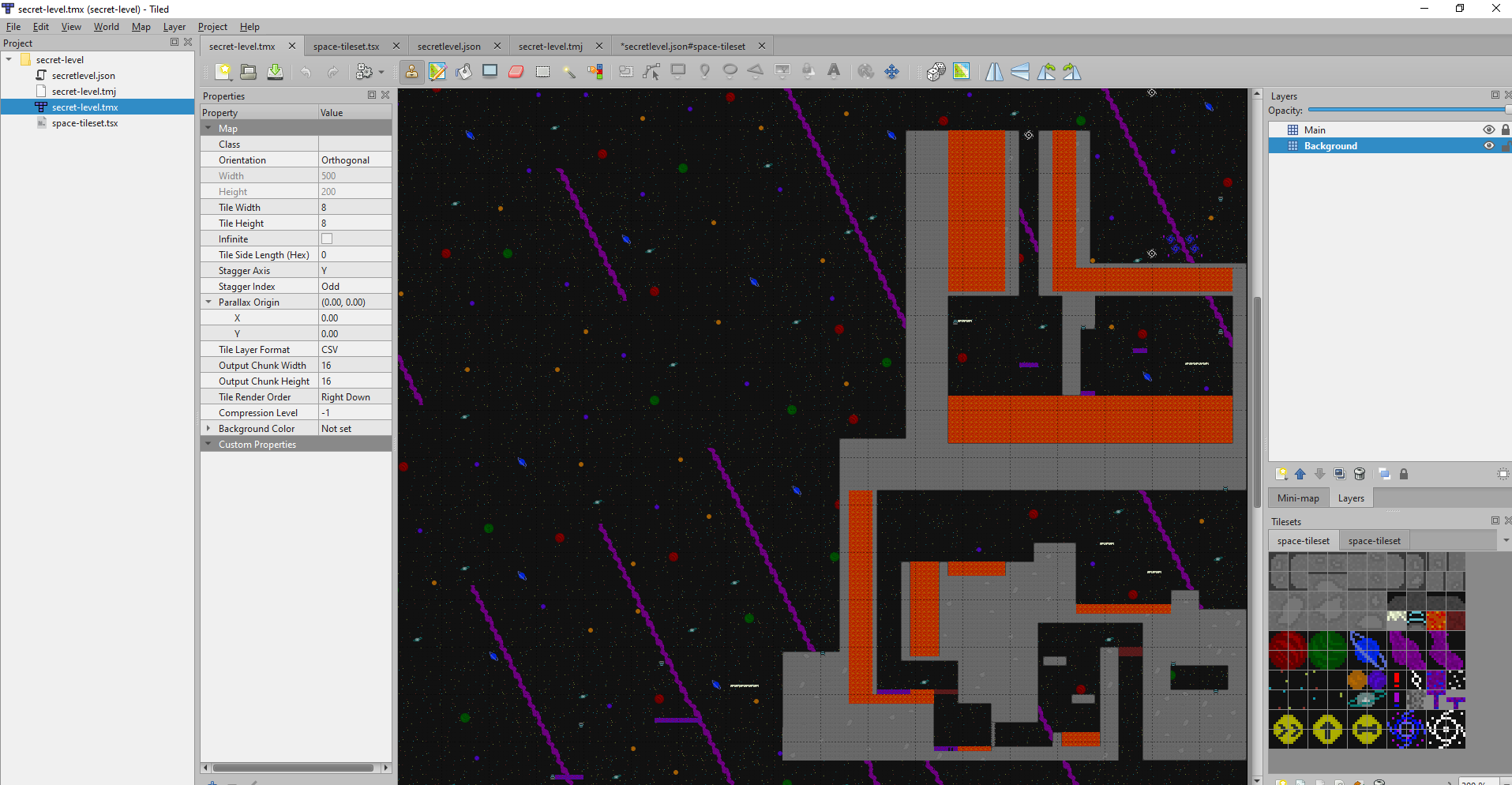
Level Design - Secret Level In Tiled (First Half)ExplanationI designed this final 'Secret Level' to be a reward after completing the game and unlocking a fun hidden mode the 'Zen' mode. This level's design was made with the idea to keep the player moving as the floors are collapsible and filled with lava pits and bottomless holes. The level contains every form of level interaction from levels 1 to 6 as obstacles to overcome in the many 'meteor rooms' that this level contains. After traversing the first meteor rooms, the player must overcome a 'free fall' section that has no meteors in sight. The space level's artwork is best seen in this area. As this 'Secret Level' is a space level, the teleport tiles and lava tiles are prevalent however, so are every other form of tile including the collapsible tile and switch tile. Prior to designing this level, I made updates to the space tilesheet a week before the SBU Game Programming Competition in order to differentiate the secret level from levels 5 and 6. This level features new aesthetic tiles from the space level tilesheet. Again, this level can only be traversed with 'Zen' mode as all other modes abilities alone are not enough. Designed as the true hardest level in the game, can you 'S'rank it? Contribution: Game FeaturesOverview (Game Features)Showcasing - Teaser Splash Screen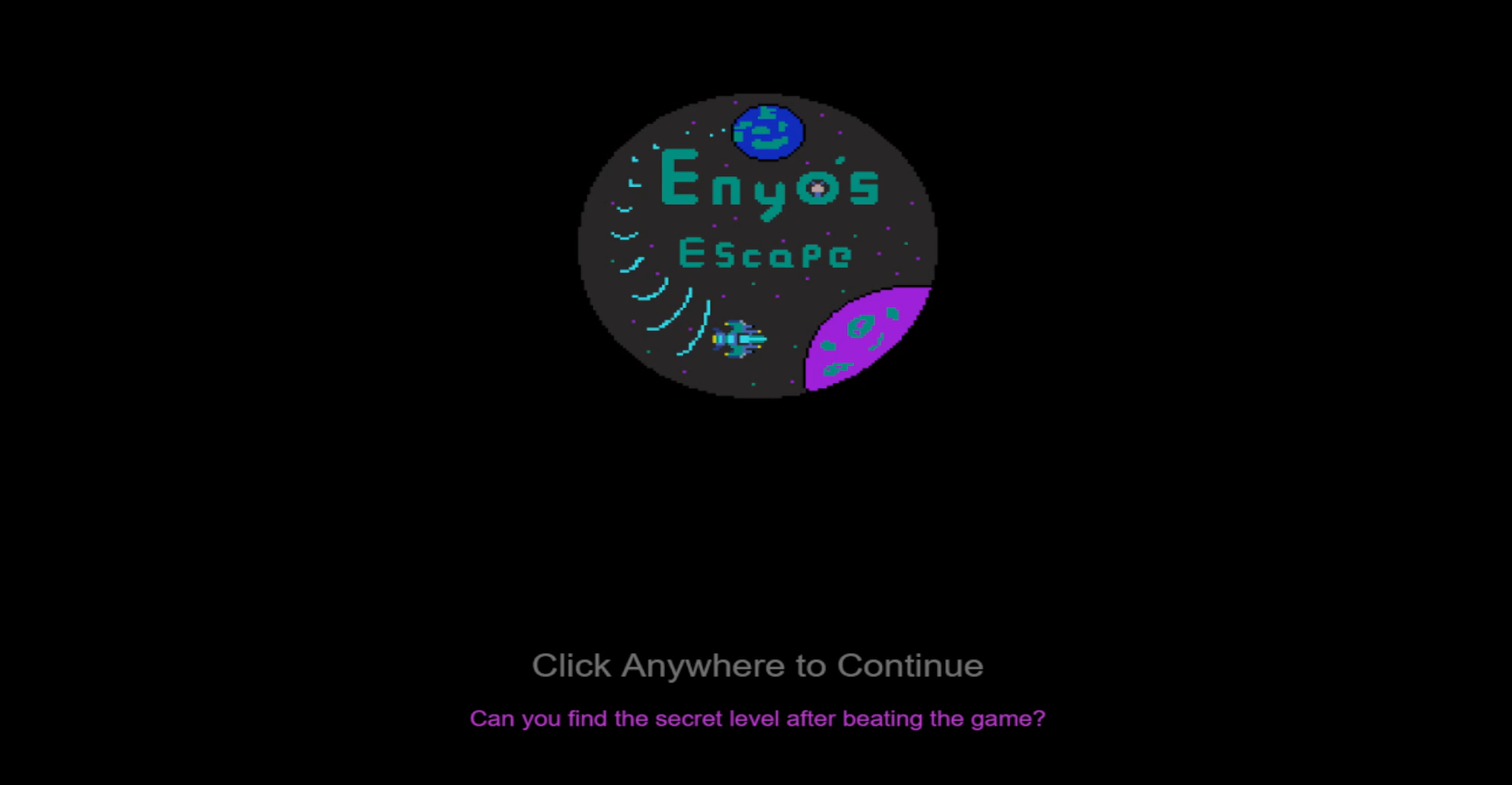
Game Features - Teaser Prompt On Splash ScreenExplanationIn this subsection I briefly go over the following game features I implemented for Enyo's Escape: With little time left before presenting the game as a Finalist at the Annual SBU Game Programming Competition and as the sole member available to present, I made the decision to address some of the feedback given to us. To summarize, play testers felt the game was fun and had potential but lacking in the reward factor. The ranking system, secret mode unlock and secret level unlock were implemented shortly and swiftly after this. Ranking System (Game Features)Showcasing - Ranking System In Action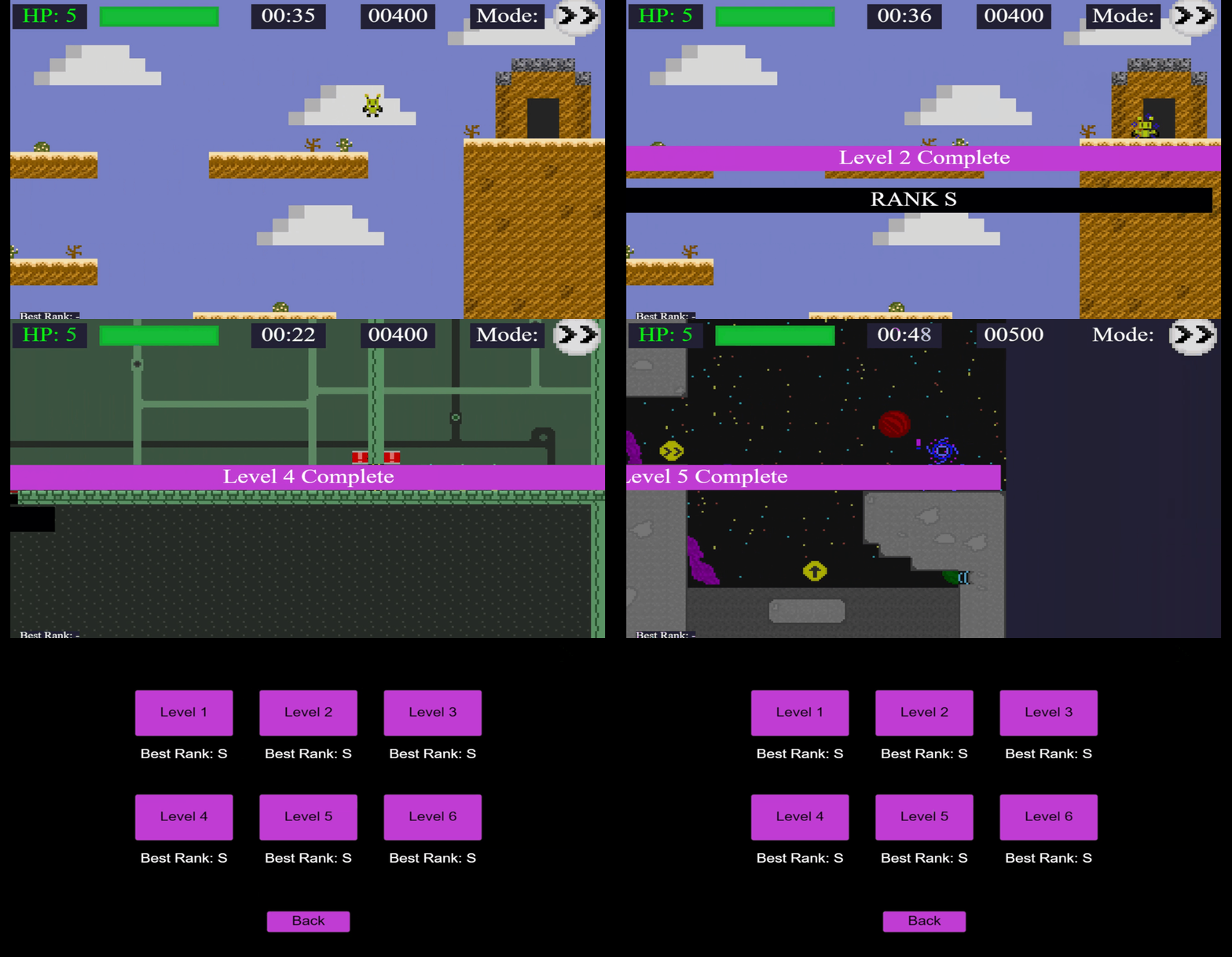
Game Features - Ranking System & Best RankExplanationFor the purpose of this game feature, I made cycling between modes be executable both in a clockwise (speed, attack, jump) and counter-clockwise fashion (attack, speed, jump). This change allowed changing between 2 modes simultaneously (i.e., speed -> jump -> speed) to be performed which greatly increased gameplay speed. Another notable addition to increase gameplay speed was to introduce the mouse click as an option for attacking. This allowed for the 'jump' mode to be used in a safer way to defeat enemies or blitzing through levels using the 'speed' mode. Achieving a time lower than the following allows for obtaining an 'S' rank in the respective stages:
Secret Mode Unlock (Game Features)Showcasing - Unlocking 'Zen' Mode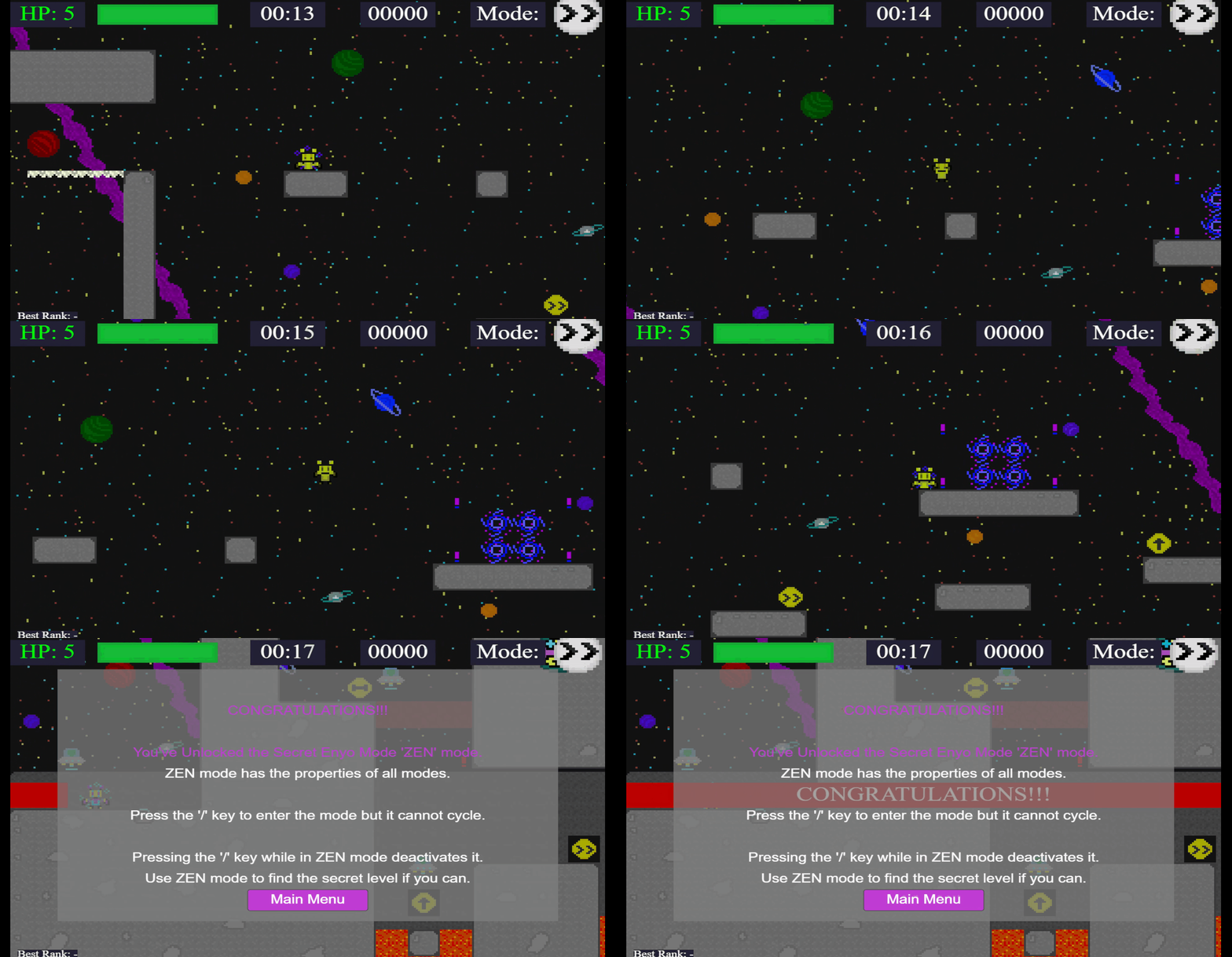
Game Features - Unlocking 'Zen' Mode (Beat Level 6)ExplanationA frequent reward from single player games is to introduce certain game-changing power-ups after completing the game to further incentivize gameplay through this replayability factor. Normally these power-ups would render previous levels obsolete in terms of offering a challenging experience. For Enyo's Escape, this makes obtaining 'S' ranks easier however the true challenge comes with the secret level that is only accessible through a specific area in the game in a certain level while using this secret mode. The secret 'Zen' mode holds the attributes of all modes in one. It jumps as high as 'jump' mode, has the speed and velocity of 'speed' mode and is a form that can attack on its own like 'attack' mode can. This mode is unlocked once beating level 6 of the game and can be activated by selecting the 'Z' key on the keyboard. Note: Once in 'Zen' mode, the player will be unable to switch to another mode. The player may only switch off 'Zen' mode through pressing the 'Z' key on the keyboard again to revert to the same form last used prior to the initial activation of this mode. More information on my contribution with the artwork for the secret mode can be found in the Secret Mode Concept Art & Animations subsection of the Contribution: Artwork section of this page. Secret Level Unlock (Game Features)Showcasing - Level 5 Secret Portal
Game Features - Secret Level (Access From Level 5)ExplanationAnother frequent reward given after game completion in single player games is to introduce more challenging levels or introduce a new difficulty level. For Enyo's Escape, I decided to increase the replayability factor by implementing the former that is to introduce a new challenging level for the player to complete after compelting the standard set of 6 levels. This plays out as follows. Entering The Secret LevelUpon completing the final level, the player gains the ability to physically access a new area of a specific level with the mobility boost provided by using 'Zen' mode. This level is on one of the space levels I designed specifically in level 5 on the left side of the rock platforms. Overlapping the white hole as demonstrated above causes the player to warp into the secret level where the use of 'Zen' mode is required to traverse the level safely as all other modes are insufficient by themselves. Note: Only while using 'Zen' mode will the warp activate. If the area is reached but the player decides to switch forms, the warp will not activate until 'Zen' mode is activated. More information on my contribution with level design for the secret level can be found in the Secret Level Design subsection of the Contribution: Level Design section of this page. More information on my contribution with the artwork for the secret level can be found in the Space Level Art subsection of the Contribution: Artwork section of this page. Level Interactions (Game Features)Showcasing - Some Level Interactions
Game Features - Some Level InteractionsExplanationEach member had a few ideas on the type of reactions certain floor tiles will and should have depending on which level the player is currently on. The general idea was to start off with easy tiles strictly for platforming purposes to slightly more difficult tiles with time-based platforming with the switch to more challenging teleport tiles and insta-kill lava tiles. Teleport InteractionThe teleport tiles only appear in the space levels. These levels are Level 5, Level 6 and the Secret Level that is only accessible through Level 5 after unlocking 'Zen' mode. These tiles simply warp the player to another part of the level but offer little to no prior warning about incoming obstacles facing the player after warping. Lava InteractionThe lava tiles only appear in the space levels. These levels are Level 5, Level 6 and the Secret Level that is only accessible through Level 5 after unlocking 'Zen' mode. These tiles serve as the game's insta-kill tiles where the player gets an instant game over if contact is made. Switch InteractionThe variant of the switch tile that appears in the desert levels appears in the Secret Level. This variant was created so that the Secret Level may make use of all types of tile interactions found in the game and offers the Secret Level time-based challenges along the heavy platforming found on this stage. Contribution: Game TrailerShowcasing - Working On Game Trailer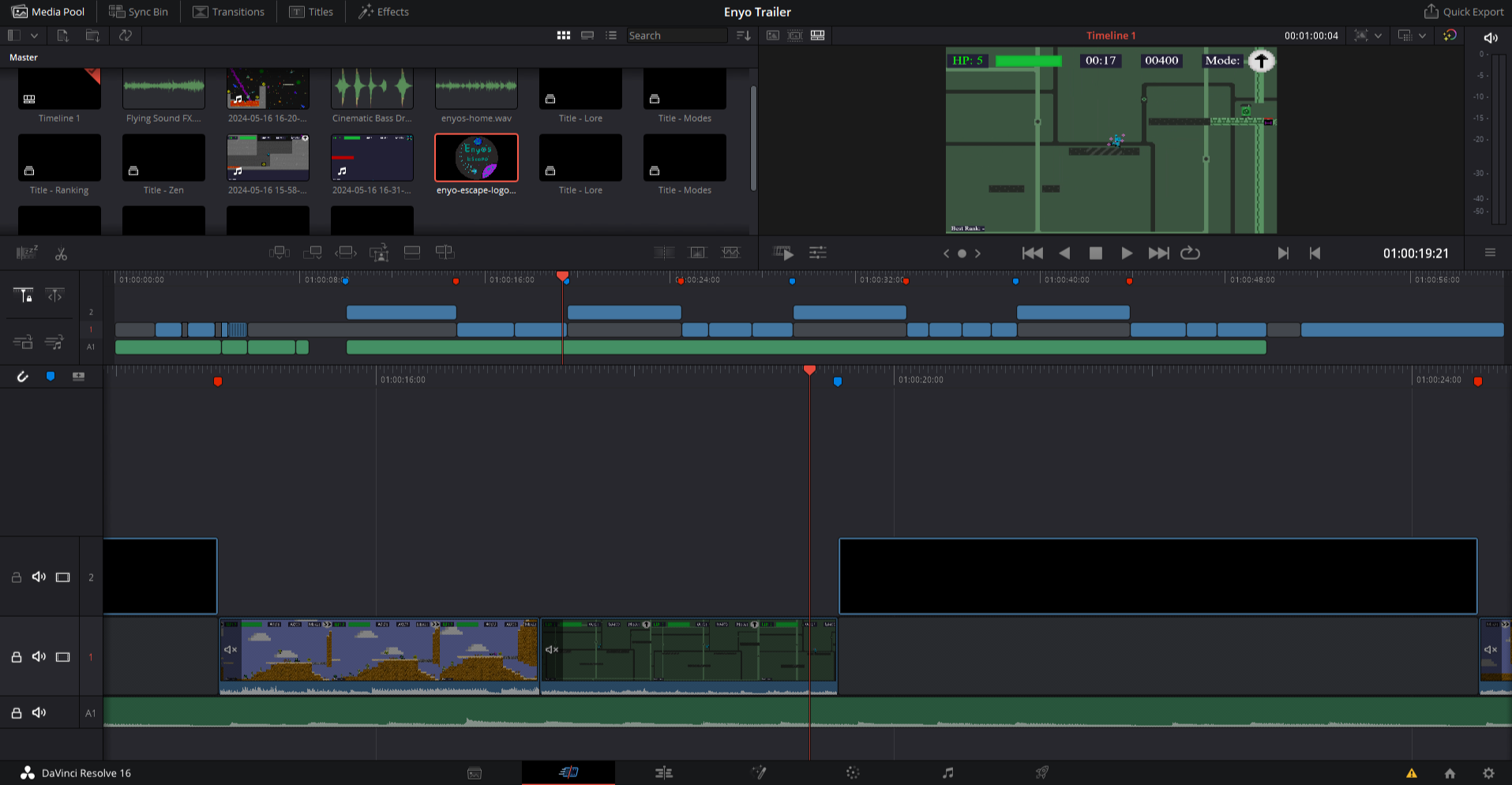
Game Trailer - Editing Trailer In DaVinci ResolveOverview (Game Trailer)ExplanationIn this subsection I briefly go over some details of the game trailer I created for the 2024 Stony Brook Game Programming Competition. There were a total of 3 technologies that I used in creating the trailer after getting an idea of what I wanted the trailer to highlight. The music, video editing and gameplay were handled by me. Note: This is the sole subsection that differs in the structure of detailing the main technologies first, instead they are mentioned last for the sake of demonstrating the thought process of the trailer first. Trailer Showcase (Game Trailer)The TrailerConcept ExplanationThe main idea of the trailer was to convey 4 main concepts of the game that would entice people to play while intentionally muting any gameplay sound in order to highlight the main theme. The highlighted features for this trailer are as follows:
Main Theme (Game Trailer)Theme ExplanationI wanted a 'bittersweet' take for the theme, a theme that could convey what a journey in isolation through unknown land for a small creature would be like. This was the main reason for ommiting any game sounds for the trailer. A choice to help viewers feel the silence and sorrow that could come from such a journey which Enyo must face alone. More on this theme is spoken of briefly in the Main Theme subsection of the Contribution: Sound section of this page. Main Technologies (Game Trailer)Showcasing - DaVinci Resolve Website
Game Trailer - DaVinci Resolve WebsiteDaVinci ResolveDaVinci Resolve was my editor of choice. My experience using this software was primarily from a few AMV's I have worked on recreationally. The software allows for easily editing both sound and video. The main difficulty I faced while editing the trailer was the use of the title slides. DaVinci is notorious for having a high learning curve for editing title effects (i.e., timing, slow-motion, lighting, placement). Because of this, when editing I used placeholder black screens while I edited the gameplay and executed titles last. Showcasing - OBS Studio Website
Game Trailer - OBS Studio WebsiteOBS StudioOBS Studio was my screen recorder of choice. My experience using this software was mainly from dabbling with recording music covers through my laptop which later was replaced with a professional camera. For this project, I used OBS Studio to record myself playing through all desert levels, lab levels and space levels as fast as needed to acquire a high rank (0:35 in trailer). As of now and for the foreseeable future, I will continue to use this software if I am needing to stream and record. Showcasing - Online Sequencer Website
Game Trailer - Online Sequencer WebsiteOnline SequencerOnline Sequencer was my audio generator of choice. This was the first time I used this software however it was very straightforward. To use it, one need select the notes on the virtual keyboard you would like to link for the track to play. Prior to generating the melody, I composed it on my keyboard before translating it on Online Sequencer. Contribution: Game LoreMain Character Name (Game Lore)ExplanationThe name of our character was debated of being one of Ziggy, Bam or Fleur, names that each member came up with. This remained a discussion until I mispronounced 'Kansas' with 'Kenya' and thought of 'Enyo' as a result. All members were suprised with the development and decided that as the name. Main Character Planet Name (Game Lore)Explanation'Midas' was the original name of the planet I proposed for Enyo's backstory. All members agreed that the name seemed a bit lacking before another member proposed it have a number associated with it to give the planet an 'unregistered planet' feeling. 'Midas 47' was the final result. Game Title (Game Lore)ExplanationThis was the final part that I contributed to the game lore. Previous names proposed by all members were 'Enyo's Journey', 'The Journey of Enyo', 'Enyoception'. After some thought of what the goal of Enyo was in this game, namely to escape Earth and journey back to his home planet, I proposed the name 'Enyo's Escape' which immediately stuck. |










Game Engine
Brief DescriptionShowcasing - UML Diagram (Game)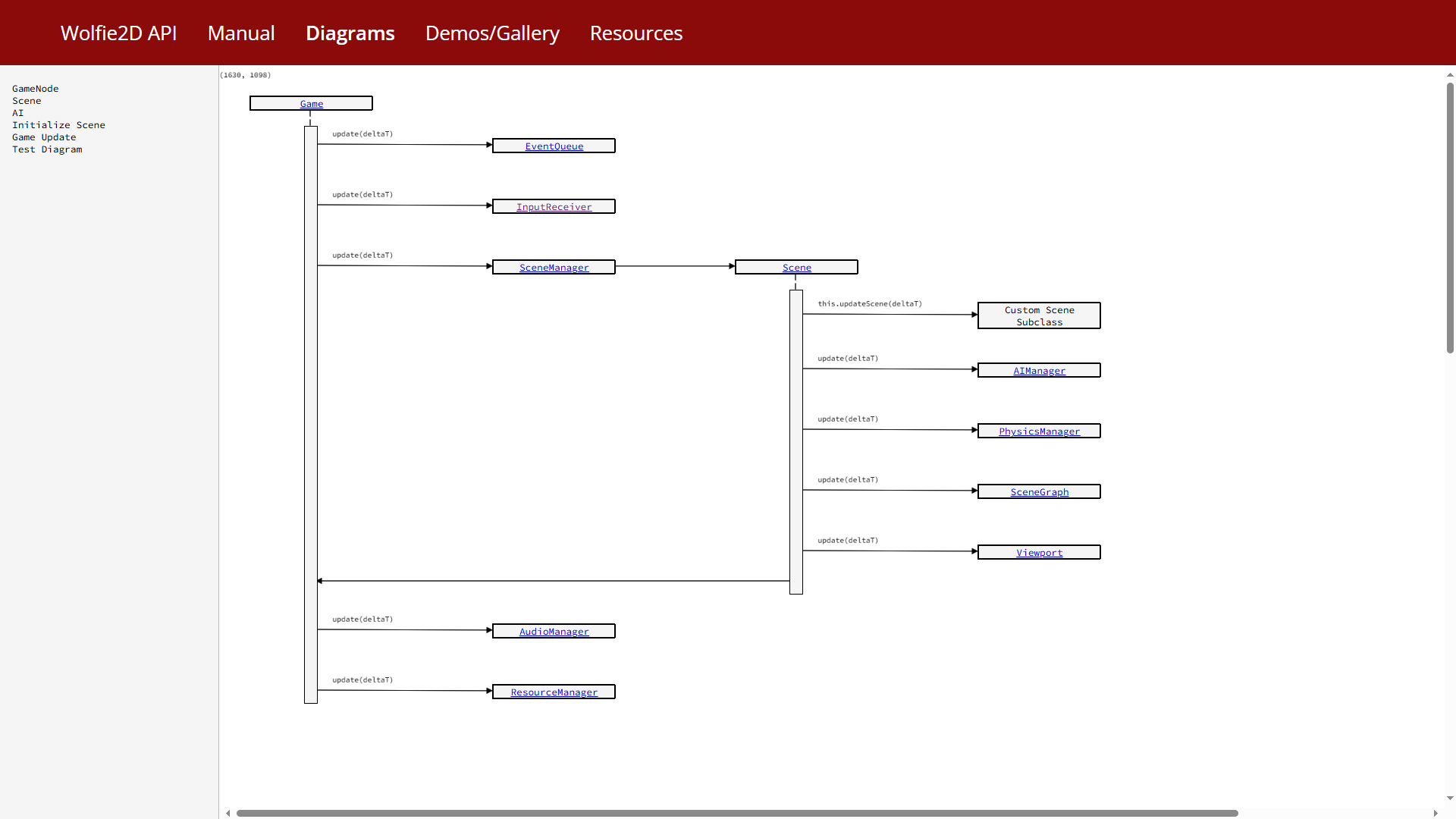
Game Engine - Wolfie2DExplanationThis project uses a game engine that was specifically designed for Game Development by Stony Brook University Computer Science students led by Professor Richard McKenna, the Wolfie2D game engine. The 2D games the engine specializes in are those of the Galaxiga-style spaceship shooters, platformers and top-down adventure style games and uses a variety of algorithms for pathfinding specifically the A-Star algorithm needed for enemy AI. Slight modifications to the hitboxes of the GameNode class had to be made in order to make Enyo's Escape AABB hitbox detection more flexible as well as to the movement which to make gameplay more fluid. Wolfie2D APIDocumentation, UML Diagrams and Demos of Wolfie2D can be found in the Wolfie2D API. |
Play Testing
Feedback RecievedShowcasing - Play Test Form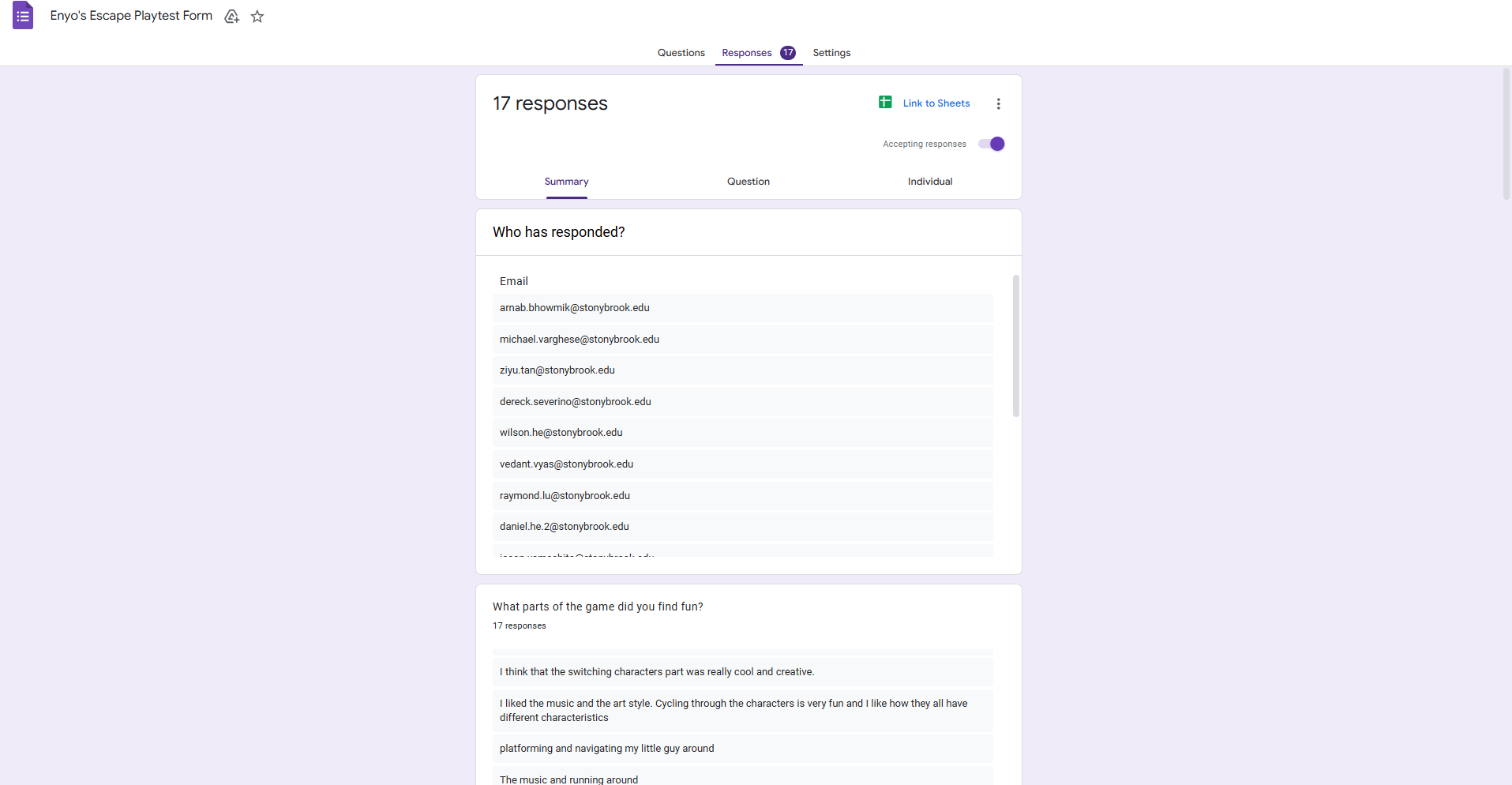
Play Testing - Enyo's Escape Play Test FormExplanationAs a part of our game development, a play test of Enyo's Escape was made by Stony Brook University's Game Development & Design Club. before becoming finalists in the Annual Stony Brook University Game Programming Competition. This was done in order to get feedback on our game to learn what our strengths were and what we could improve on.
Notable Comments
Notable Concerns
Overall ConsensusThe overall positive feedback was the art and music of the game with mixed reviews on the movement of the game with some players expressing concern with the jump mechanics and others content with the speed of the game. Thus for the remaining time of the project up until then focus was to be placed on the core gameplay. The overall negative feedback was that the game felt a tad lacking or simple which I interpreted as a lack of reward in playing the game and personally took as a challenge as to how to make Enyo's Escape more challenging. Other concerns included a few glitches that needed to be addressed such as bottomless pits as well as some clunky movement the game had. Action TakenShowcasing - Creating Unlockable Reward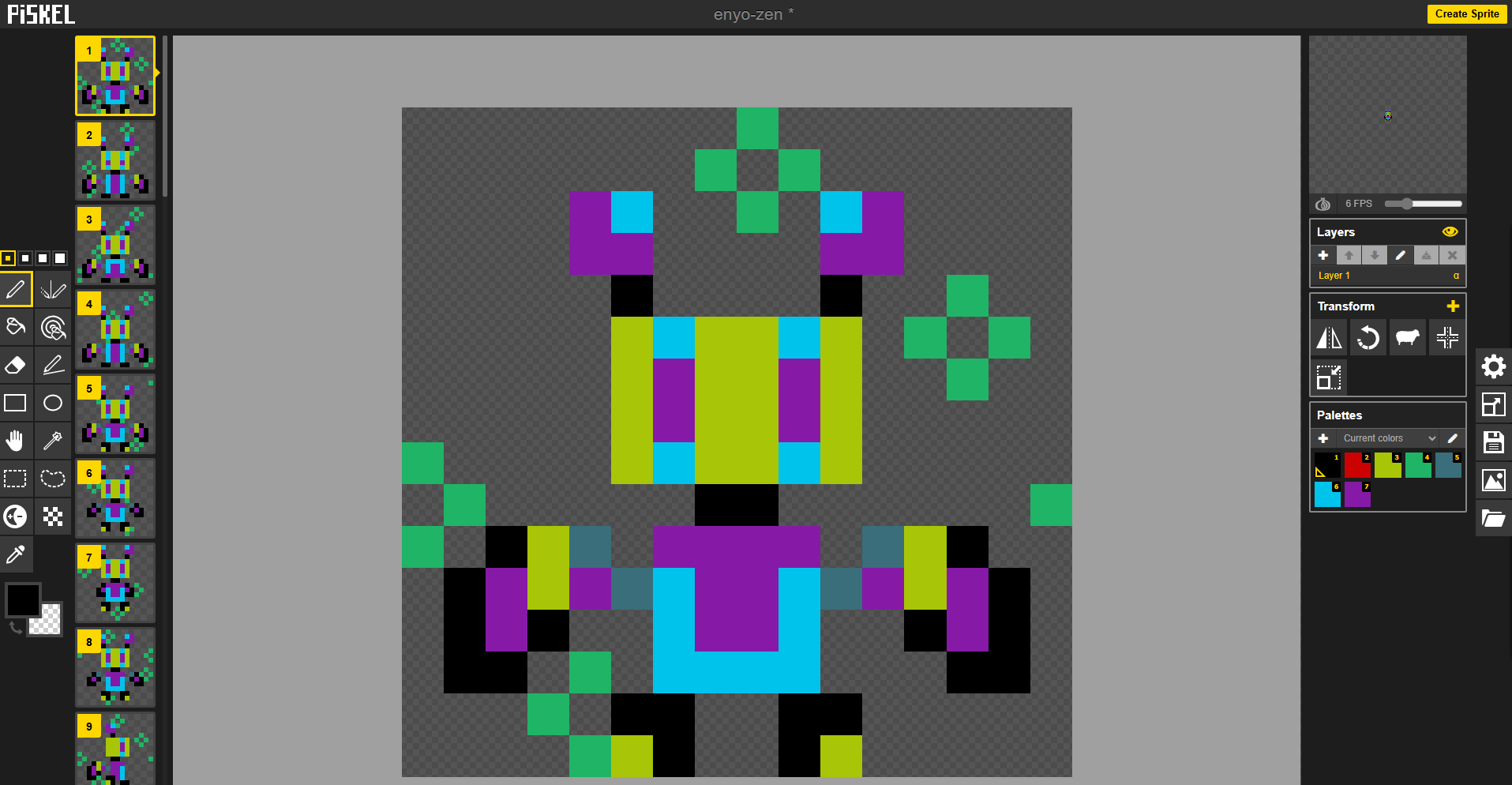
Play Testing - Taking Action On FeedbackRanking SystemAlthough most of the players expressed contentment with the state of the game, some expressed a lack of engagement or a lack of reward for performing exceptional (examples of these types of comments are in 'Notable Concerns' above). This lead to the implementation of a ranking system for Enyo's Escape for replayability and reward factor. More information on the ranking system can be found in the Ranking System subsection of the Contribution: Game Features section of this page. Secret Character ModeAs part of the reward factor spoken briefly of above, a secret character mode was made unlockable upon completing the final level in the game which was designed to be the most difficult. More information on the secret character unlock can be found in the Secret Mode Unlock subsection of the Contribution: Game Features section of this page. Secret LevelTaking the reward factor a step further, once the secret mode is unlocked, it can be used to enter a special level that is hidden in the game which requires the heavy use of this secret mode. All other modes are not strong enough for this level. More information on the secret level unlock can be found in the Secret Level Unlock subsection of the Contribution: Game Features section of this page. |
Conclusion
Final ResultShowcasing - A Few Competition Finalists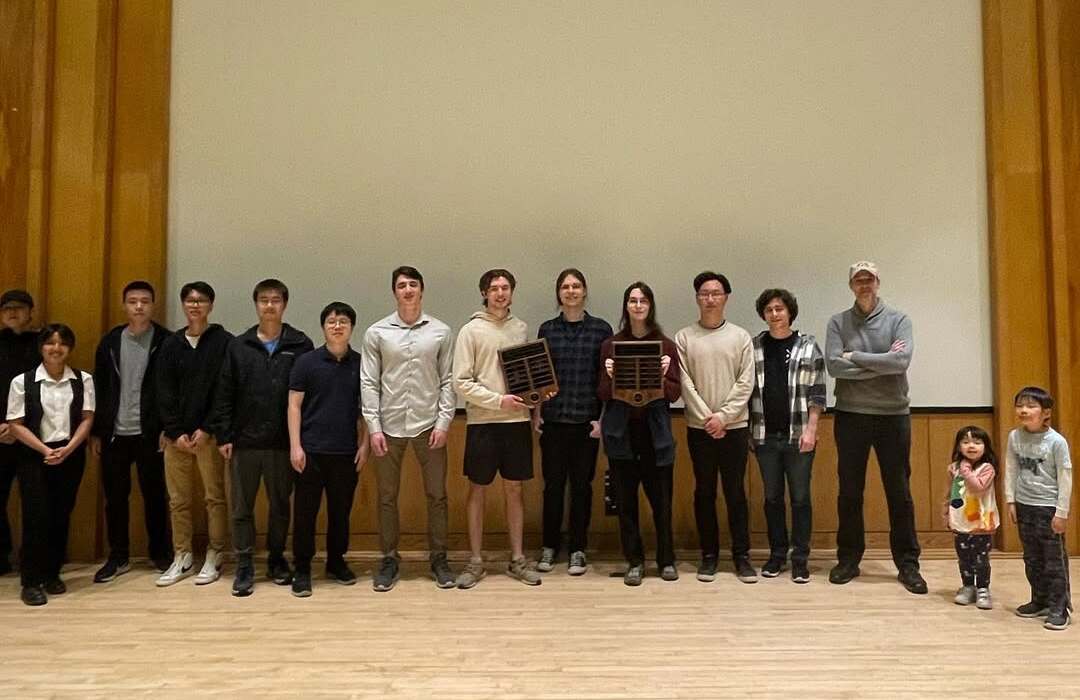
2024 SBU Annual Game Programming CompetitionTechnologies Learned and Experiences GainedInitially, setting the goal on entering and becoming a finalist at the 2024 Stony Brook Game Programming Competition was made to gain experience on working in a team with a language not familiar to us while also creating a fun game. Early on however, I understood how personal this project would become to me when elements I proposed were voted in and when it became evident that my hobbies with the arts could be potential assests for Enyo's Escape. Upon actualization of the goal on becoming a Finalist, the last member available to represent Enyo's Escape for the competition was myself which was incidentally finals week and the week I worked on the Game Trailer. The experiences gained however proved invaluable in helping our understanding with typescript, game design, 2d-pixel art, sound design, deploying on firebase and of course, teamwork. Note: Not all members of winning games were able to make it to the 2024 Annual Game Programming Competition due to finals or other responsibities. A single team member of a finalist game was sufficient to represent that game. |